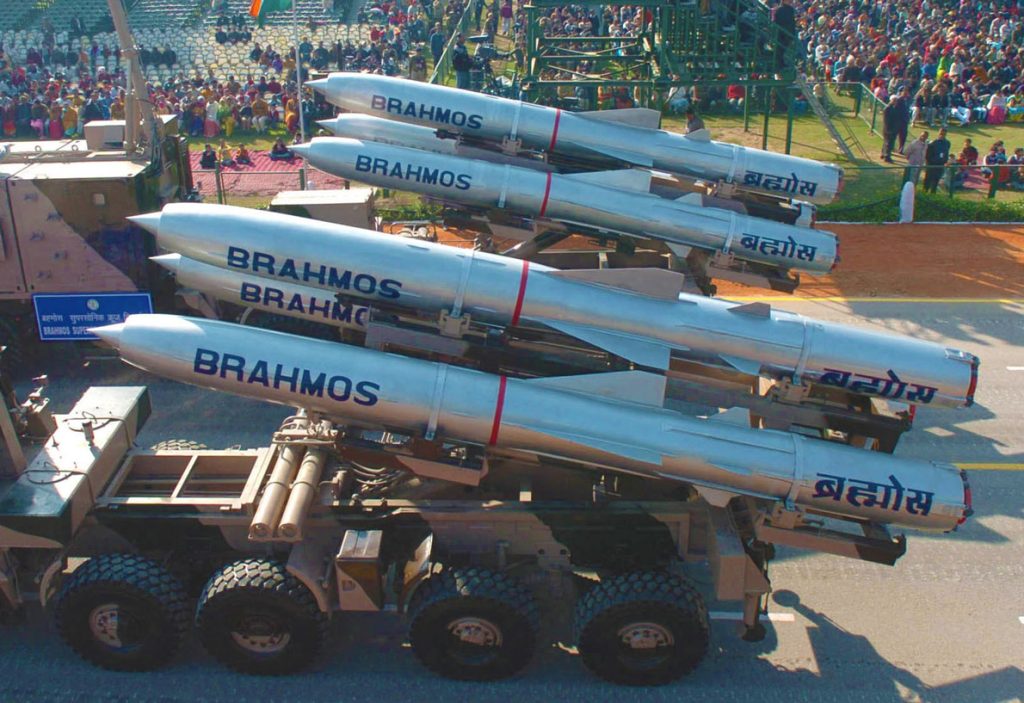
The BrahMos supersonic cruise missile, a flagship Indo-Russian joint venture, is witnessing unprecedented global interest and operational expansion, cementing its status as one of the most sought-after precision strike systems in the Indo-Pacific and beyond.
Once primarily a mainstay of the Indian armed forces, the missile, capable of speeds up to Mach 3 and precision strikes from multiple platforms, has now become a key driver of India’s ambitious defence export goals. BrahMos Aerospace reported revenues exceeding ₹5,200 crore in FY 2025-26, supported by fresh export orders worth around ₹4,000 crore (approximately $455 million).
Export Breakthroughs in Southeast Asia
The Philippines became the first export customer in 2022 with a $375 million deal for shore-based anti-ship batteries. Deliveries of the first and second batches have strengthened Manila’s coastal defence amid South China Sea tensions.
Vietnam has now formally signed a deal for the system, while Indonesia is in the final stages of finalising its acquisition, potentially making it the third Southeast Asian operator.
These moves reflect growing demand among nations seeking high-speed, versatile anti-access/area-denial capabilities without the political strings often attached to Western systems. Reports indicate interest from up to a dozen countries, including others in the Global South, as BrahMos positions itself as a combat-proven, cost-effective option.
Defence Minister Rajnath Singh and officials have highlighted these deals as milestones for the ‘Make in India’ initiative. A new integration and testing facility in Lucknow has ramped up production, with the first indigenous batches already delivered to Indian forces and export commitments.
Technological Evolution and Domestic Integration
On the capability front, development of the lighter, stealthier BrahMos-NG (Next Generation) variant is advancing rapidly. Expected to weigh about half of the original while maintaining high supersonic speeds, the NG version offers greater platform flexibility, including easier integration with a wider array of fighter jets like the Tejas and reduced radar signature. First flight trials are anticipated later in 2026, with production slated for 2027-28.
India’s armed forces continue to induct extended-range variants, with the Army and Air Force preparing for significant additional orders. The missile’s multi-platform versatility (land, sea, air, and potentially submarine) has made it a force multiplier in India’s strategic posture.
Strategic Ripple Effects
Analysts point to the ‘China factor’ as a key driver behind regional demand.
Nations facing maritime assertiveness in the South China Sea view BrahMos as a reliable deterrent capable of altering the balance in littoral waters. For India, the exports not only boost economic self-reliance (with defence exports hitting record highs of over ₹38,000 crore in FY 2025-26) but also deepen strategic partnerships in the Indo-Pacific.
BrahMos Aerospace, the joint venture between DRDO and Russia’s NPO Mashinostroyenia, continues to expand its domestic industry ecosystem, involving over 200 Indian firms. This indigenisation push aligns with broader goals of reaching $5 billion in annual defence exports by 2030.
As BrahMos transitions from a national asset to a global brand, its rising prominence underscores India’s maturing role as a defence technology supplier and security partner. With more deals on the horizon and next-generation upgrades in the pipeline, the missile could shape both battlefield realities and geopolitical alignments in the years ahead.