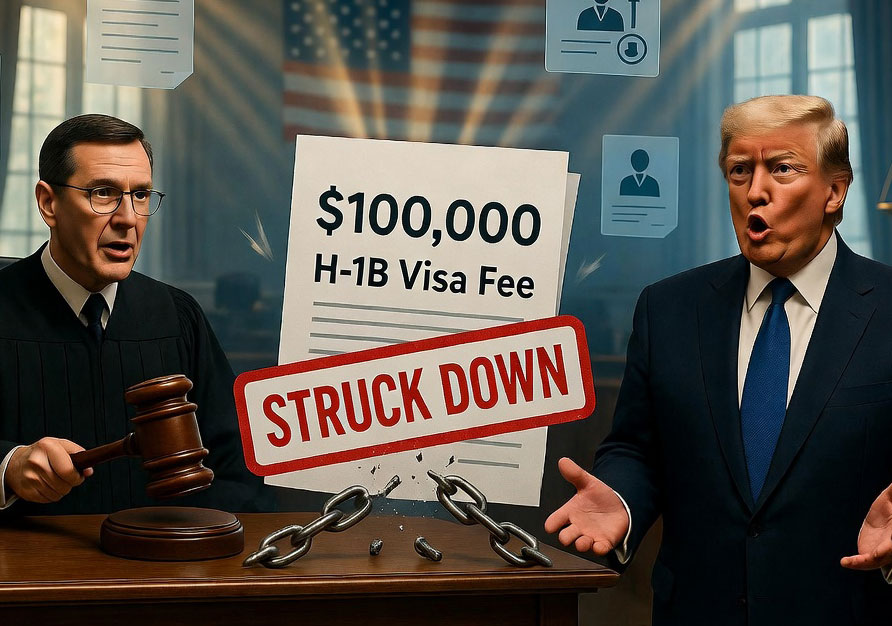
In a setback for the Trump administration’s immigration enforcement efforts, a federal judge on Monday invalidated a controversial $100,000 fee imposed on new H-1B visa applications, ruling that the policy exceeded presidential authority and effectively functioned as an unauthorized tax.
US District Judge Leo Sorokin of the District of Massachusetts issued the ruling in a lawsuit brought by a coalition of 20 Democratic-led states, led by California. The states argued that the steep charge, introduced through a September 2025 presidential proclamation, severely hampered their ability to recruit talent for public universities, hospitals, K-12 schools, and critical STEM and healthcare positions.
The fee, which applied primarily to new H-1B petitions for workers currently outside the United States, was part of broader efforts to reform the visa program to protect American workers and curb perceived abuses. It represented a dramatic increase from standard filing fees and was intended to last for 12 months.
In a detailed memorandum, Judge Sorokin, an Obama appointee, determined that the payment’s structure and impact classified it as a tax rather than a legitimate regulatory fee or penalty. ‘The substance and application of the $100,000 payment reveal that it is a tax, regardless of what the payment is called,’ he wrote. He concluded that the executive branch lacked the constitutional and statutory power to impose such a charge without explicit congressional approval, violating separation of powers principles.
The decision vacates the policy nationwide, providing immediate relief to employers, universities, and technology firms that rely on the H-1B program to fill specialized roles. It contrasts with an earlier ruling by a different federal judge in Washington DC, who had upheld the fee in late 2025.
Reactions poured in quickly. Tech industry groups and business chambers welcomed the ruling as a victory for American innovation and global competitiveness. Conversely, supporters of stricter immigration controls criticized the decision as judicial overreach that undermines efforts to prioritize US workers.
The White House signaled it would appeal the ruling, potentially setting the stage for further litigation in higher courts. Administration officials maintained that the measure was a lawful exercise of authority under the Immigration and Nationality Act to regulate entry and protect domestic employment.
H-1B visas allow US employers to hire foreign workers in specialty occupations requiring specialized knowledge, such as engineering, medicine, and information technology. The program has long been a flashpoint in debates over skilled immigration, with annual demand far exceeding the congressionally mandated cap.
As the legal battle continues, employers are reportedly being advised to proceed with standard H-1B processes without the additional fee while monitoring developments. The ruling comes amid ongoing national discussions about balancing workforce needs with immigration priorities in a competitive global economy.