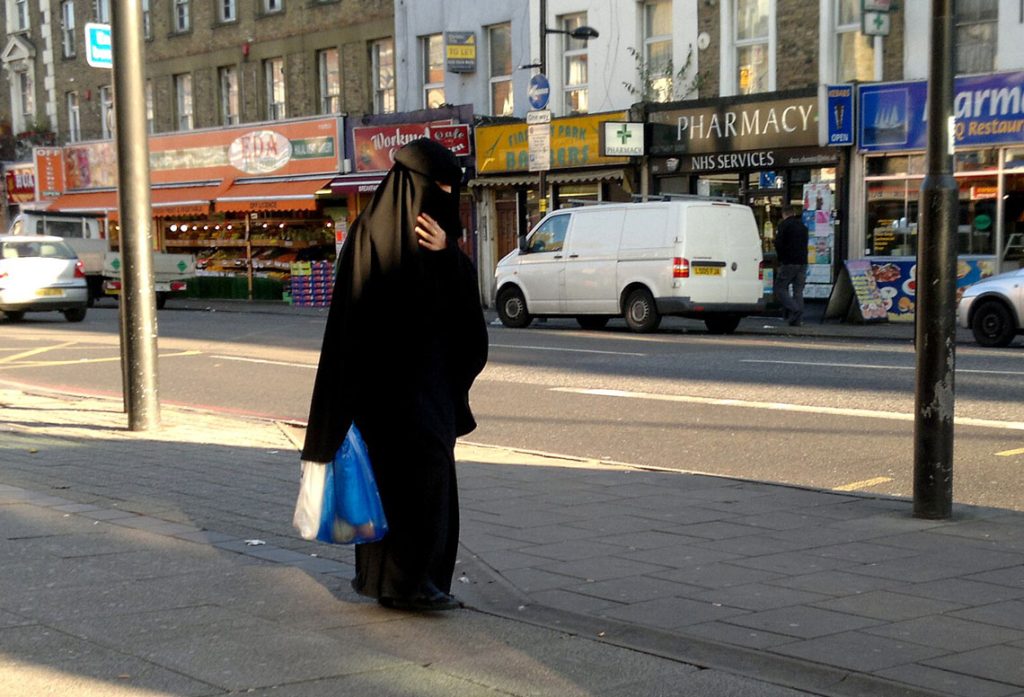
Recent social media discussions, including high-profile posts highlighting groups of women in burqas or niqabs in British public spaces, have reignited debates about rapid cultural and demographic change in the United Kingdom.
Terms like ‘Islamic invasion’ are provocative and historically loaded, evoking conquest rather than voluntary migration and births. However, underlying concerns about population trends, integration challenges, and cultural cohesion rest on verifiable data rather than pure rhetoric.
Demographic realities
The UK’s Muslim population has grown significantly. According to the 2021 Census and subsequent analyses, Muslims number around 4 million, or roughly 6-6.5% of the UK’s population of about 67-69 million. This represents an increase from about 2.7-2.8 million (4.9%) in 2011 and under 2% in 2001. Much of this growth stems from higher fertility rates (Muslim women of childbearing age have more children on average), a younger median age (around 27-28 compared to the national average of about 40), immigration, and family reunification.
Projections from Pew Research (2017, with trends holding) suggest that under medium migration scenarios, the Muslim share could reach around 17% by 2050 in the UK, similar to France. In a zero-migration scenario, it would still rise to about 10% due to demographic momentum. These are not ‘invasion’ figures but reflect standard population dynamics – younger cohorts and differential birth rates drive change even without new arrivals.
Recent net migration has slowed. In the year ending December 2025, long-term net migration stood at approximately 171,000, down sharply from peaks of over 600,000-700,000 in prior years. Immigration totaled around 813,000, with non-EU nationals dominant. Asylum applications have also declined somewhat, though small boat crossings remain a visible political flashpoint.
Immigration
The UK, like much of Western Europe, has experienced substantial post-war immigration from South Asia, Africa, and the Middle East, accelerated by EU free movement (pre-Brexit), labor needs, study visas, and humanitarian policies. Non-EU migration, including from Pakistan, Bangladesh, and various Muslim-majority countries, has been a key driver of Muslim population growth. Many arrivals integrate successfully as workers, students, and entrepreneurs, but challenges persist in specific communities.
Visible symbols like the burqa or niqab, worn by a minority of Muslim women (estimates suggest full face veils are rare, though exact figures vary), fuel perceptions of parallel societies, especially in areas with high concentrations such as parts of London, Birmingham, Bradford, and Leicester. These neighborhoods sometimes show lower employment rates, higher welfare dependency in some subgroups, and reports of social conservatism that clash with mainstream British values on issues like gender roles, free speech, and secularism.
Integration challenges
Factual concerns include well-documented grooming gang scandals in Rotherham, Rochdale, and other towns, where organized groups, disproportionately of Pakistani heritage, exploited vulnerable girls over the years. Official inquiries highlighted failures by authorities, partly due to fears of ‘racism’ accusations. Elon Musk and others have publicly highlighted these cases, drawing attention to patterns of group-based sexual exploitation.
Broader statistics show overrepresentation in certain crime categories (e.g., some grooming or honor-based violence reports), though the vast majority of Muslims are law-abiding. Terrorism remains a risk: Islamist-inspired attacks have killed dozens in the UK since 2001, from 7/7 to Manchester Arena and Reading. MI5 and police continue to monitor threats from radicalization, often linked to online networks or specific mosques/preachers.
On the positive side, many British Muslims identify strongly as British, serve in the armed forces and the NHS, and show rising educational attainment. Second- and third-generation integration improves in language, employment, and intermarriage in some groups, though parallel communities with Sharia councils or resistance to secular norms exist in pockets.
No literal ‘Invasion’
There is no coordinated military or ideological ‘invasion’ by any state or caliphate. The UK retains full sovereignty over borders, citizenship, and law (despite EU legacy influences). Changes result from policy choices on immigration, asylum, and multiculturalism since the 1990s/2000s, combined with low native birth rates (below replacement level across Europe). Without net migration, the UK population would eventually decline.
Critics argue that rapid, large-scale immigration from culturally distant regions, without robust assimilation expectations, risks social fragmentation, citing rising antisemitism post-October 2023, protests with extremist rhetoric, and polling showing significant minorities holding views incompatible with liberal democracy (e.g., on apostasy, homosexuality, or blasphemy). Supporters emphasize economic benefits, diversity, and Britain’s long history as an immigrant nation (from Huguenots to Windrush).
Recent policy shifts under successive governments have aimed to reduce numbers and prioritize skilled migration. Public opinion polls consistently show majorities favoring lower immigration. The ‘invasion’ framing is hyperbolic, but dismissing concerns as mere prejudice ignores measurable demographic trajectories, integration gaps, and specific cultural incompatibilities documented in government reports and academic studies.
The UK faces a classic policy question – Can high inflows from high-fertility, religiously conservative backgrounds be balanced with social cohesion? Data suggests partial success alongside persistent challenges. Addressing it requires honest debate, evidence-based policy on borders and integration, and avoidance of both denialism and alarmism.