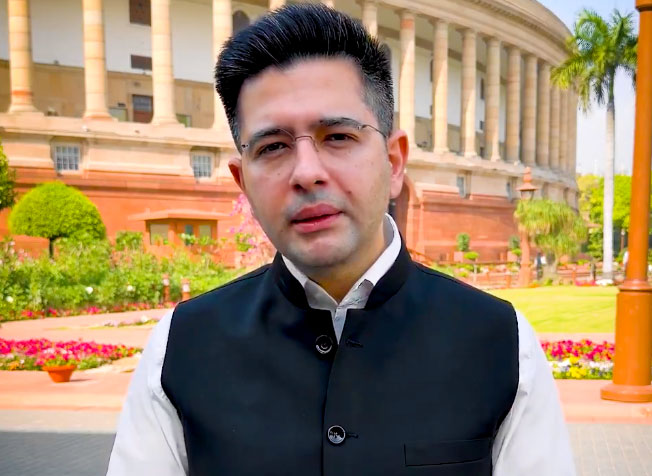
In a dramatic political realignment, senior Aam Aadmi Party (AAP) leader and Rajya Sabha MP Raghav Chadha announced his resignation from the party on Friday, declaring that he and six fellow Upper House members would merge with the Bharatiya Janata Party (BJP).
The move, framed as an exercise of constitutional provisions allowing a two-thirds faction to switch sides without facing disqualification, has slashed AAP’s Rajya Sabha strength from 10 to just three MPs, dealing a severe setback to Arvind Kejriwal’s already embattled outfit.
Addressing a joint press conference alongside MPs Sandeep Pathak and Ashok Mittal, Chadha, who had served the party for 15 years, said AAP had ‘deviated from its path’ of public welfare and honest politics. He described himself as ‘the right man in the wrong party’ and accused the leadership of straying from core principles.
The seven departing MPs include Chadha, Pathak, Mittal, Swati Maliwal, Harbhajan Singh, Vikram Sahney, and Rajinder Gupta. Citing signed documents submitted to the Rajya Sabha Chairman, Mr. Chadha asserted that this group constitutes more than two-thirds of the party’s Upper House contingent, enabling a formal merger with the BJP.
The exodus comes barely three weeks after AAP removed Chadha as its Rajya Sabha deputy leader on April 2, replacing him with Ashok Mittal and instructing the House secretariat not to allot him speaking time from the party’s quota. That demotion had already fuelled speculation of deepening internal rifts, with MP Chadha maintaining a conspicuous silence on several party crises and later posting videos highlighting his parliamentary interventions as a subtle rejoinder.
The remaining three AAP Rajya Sabha MPs, Sanjay Singh, ND Gupta, and Balbir Singh Seechewal, have pledged loyalty to Kejriwal. Party sources indicated AAP would immediately move to seek disqualification of the seven defectors under the anti-defection law, arguing the switch does not qualify as a legitimate merger. AAP leaders have labelled the development ‘Operation Lotus,’ accusing the BJP of engineering the split through inducements and pressure, particularly in Punjab.
The timing and scale of the rebellion expose structural vulnerabilities within AAP. Once hailed as a disruptive force built on anti-corruption rhetoric and grassroots mobilisation, the party has faced repeated high-profile exits since its inception. Mr. Chadha’s departure is especially symbolic. He is noted as a polished, nationally visible face who rose rapidly under Kejriwal’s mentorship, and his exit signals not just a numerical loss but an erosion of the party’s intellectual and parliamentary bench strength.
With Lok Sabha numbers already modest, AAP’s total parliamentary footprint shrinks dramatically, potentially weakening its ability to influence debates or hold the government accountable in the Upper House.
For the BJP, the influx strengthens its Rajya Sabha numbers at a time when coalition arithmetic remains fluid, while projecting AAP as a party in decline.
Legal experts remain divided on whether the two-thirds rule will shield the MPs from disqualification, with the matter likely heading to the Rajya Sabha Chairman or courts for adjudication.