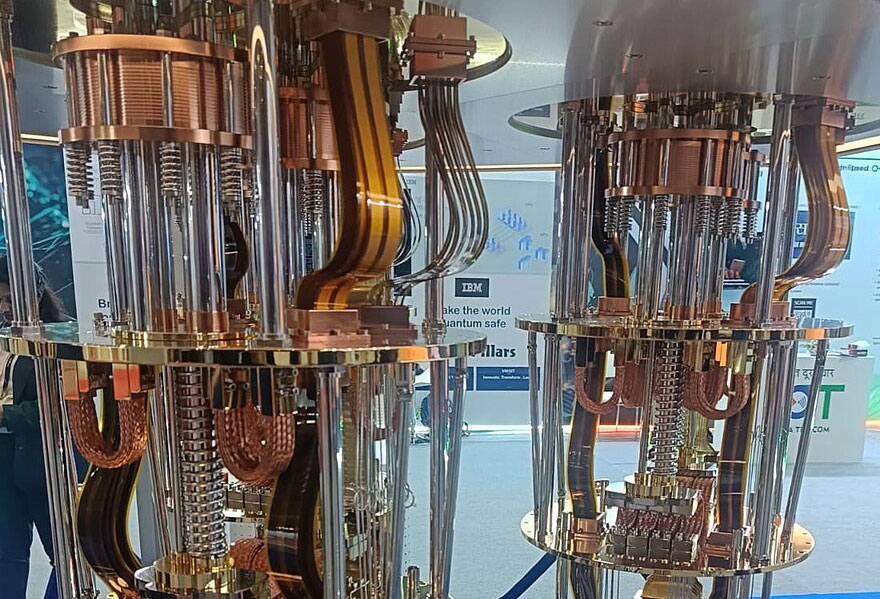
Barely ten days after Chief Minister Chandrababu Naidu formally commissioned India’s first indigenous open-access quantum computing testbeds on World Quantum Day, Andhra Pradesh is accelerating its ambitious push to transform the state’s nascent capital into a national hub for quantum technologies.
The twin facilities, the 1Q reference unit at Medha Towers in Gannavaram and the 1S superconducting demonstration platform at SRM University Amaravati, represent more than symbolic infrastructure. They mark the practical beginning of the Amaravati Quantum Valley (AQV) initiative, an integrated ecosystem designed to bridge hardware validation, talent development, and industrial application in a field long dominated by a handful of global powers.
Launched under the broader Amaravati Quantum Valley Declaration adopted in mid-2025, the state’s strategy rests on a multi-pronged approach: building sovereign test and certification capabilities, fostering domestic manufacturing supply chains, scaling specialised skilling programmes, and attracting private investment in full-scale quantum systems.
The recent inauguration of the 1Q and 1S platforms, developed with indigenous technology partners including Qubitech, underscores a deliberate focus on open-access models. Unlike many high-security quantum labs worldwide, these facilities allow researchers, startups, students, and even external institutions to book time for algorithm testing, hardware benchmarking, and real-world validation under operational conditions such as operating at temperatures approaching absolute zero.
This infrastructure rollout aligns with longer-term targets outlined in the Andhra Pradesh Quantum Computing Policy 2025–30 and the state’s Quantum Mission. By January 2029, the state eyes cumulative investments approaching $1 billion, the installation of multiple quantum computers across different technological modalities, the ability to test over 1,000 quantum algorithms, and progress toward 1,000 logical qubits of computing capacity.
Major industry commitments are already materialising. IBM is preparing to deploy one of its advanced systems at the Quantum Valley Tech Park, while Microsoft has signalled a substantial ₹1,772-crore proposal for a 1,200-qubit facility (targeting around 50 logical qubits). Collaborations with Tata Consultancy Services (TCS), Larsen & Toubro for cryogenic infrastructure, and academic partners further bolster the ecosystem.
A critical pillar of the vision is human capital. The state has rolled out one of India’s largest quantum skilling initiatives, drawing tens of thousands of student registrations in its early phases through partnerships with institutions like the Washington Institute for STEM, Entrepreneurship, and Research (WISER) and domestic players. Plans include establishing a dedicated Quantum and AI University campus in Amaravati in coordination with NIELIT. Chief Minister Chandrababu has also publicly offered a ₹100-crore incentive for any Andhra Pradesh-linked researcher who secures a Nobel Prize in quantum-related fields, intending serious long-term commitment and inspiring young talent.
Analytically, Andhra Pradesh’s approach stands out for its speed and pragmatism. In roughly 14 months since the core idea gained momentum, the state has moved from policy frameworks to live, accessible hardware. By prioritising reference testbeds before full commercial machines, the government is addressing a classic adoption barrier, that is,applications cannot scale without reliable, locally accessible validation platforms, and investment follows demonstrated ecosystem readiness.
The open-access design also complements India’s National Quantum Mission by democratising access, potentially positioning Amaravati as a service hub for other states and national R&D efforts in areas such as cryptography, drug discovery, materials science, optimisation, and defence.
Challenges remain formidable.
Quantum hardware demands extreme precision in cryogenics, vibration isolation, and error correction, the domains where India still relies heavily on imported components and expertise. Sustaining momentum will require not only attracting global players but also nurturing a robust local supply chain for qubits, control electronics, and supporting technologies. Competition from established quantum hubs in Karnataka, Telangana, and international centres adds pressure, while translating skilling numbers into high-quality research output and startup success will test the ecosystem’s depth.
Nevertheless, the early momentum is tangible. With the Medha Towers and SRM University facilities now operational and bookings opening to external users, Andhra Pradesh has shifted the narrative from aspiration to implementation. CM Chandrababu has repeatedly framed the effort as a ‘lead, not follow’ strategy, emphasising that Amaravati aims to produce quantum computers for both domestic needs and global markets within a compressed timeframe.
As results from the initial testbed operations begin to emerge in the coming months, the real measure of success will lie in whether these quantum towers catalyse a self-reinforcing cycle of innovation, investment, and talent retention. For a state historically rooted in agriculture and conventional IT services, the pivot toward frontier quantum computing reflects a calculated bet on high-value, future-ready growth.