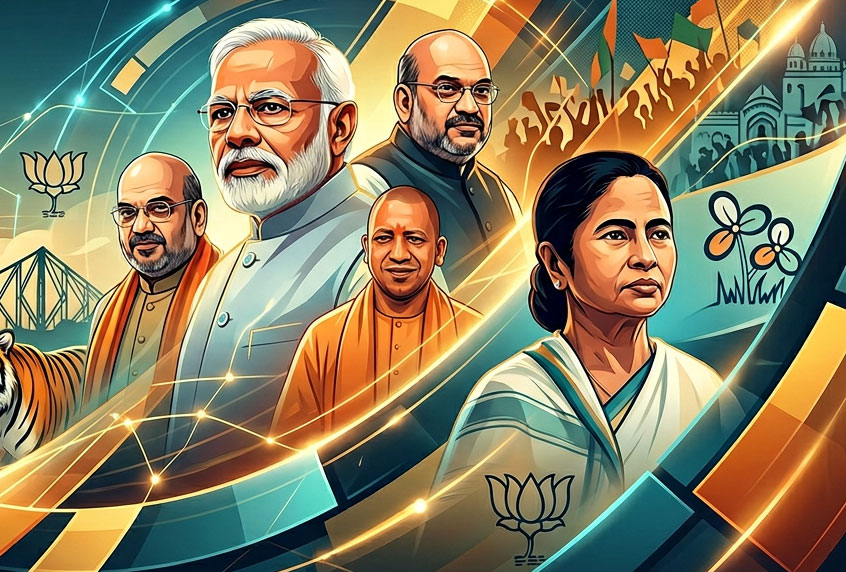
As the dust settles on the first phase of West Bengal’s assembly elections, with over 92 % voter turnout recorded on April 23, the Bharatiya Janata Party (BJP) is projecting it as an unstoppable wave.
Prime Minister Narendra Modi has framed the record participation as a sealed mandate for change. Union Home Minister Amit Shah, fresh from the polling booths, posted a sunset video declaring that ‘the sun of TMC’s corruption and hooliganism has set.’
Uttar Pradesh Chief Minister Yogi Adityanath, meanwhile, has toured key pockets like Howrah, promising a new political era. Together, the trio has orchestrated what party insiders call a meticulously layered offensive aimed at ending Mamata Banerjee’s 15-year grip on power.
But will this star-studded blitzkrieg translate into victory when votes are counted on May 4? The numbers tell a story of ambition meeting reality. In 2021, the BJP surged from just three seats to 77 on the back of a 38% vote share, yet fell short of challenging the Trinamool Congress’s (TMC) 215-seat fortress.
This time, the party has set its sights higher with internal targets hovering around 170 seats for a majority in the 294-member assembly, by zeroing in on the 50-odd constituencies where TMC won by razor-thin margins in the last outing.
Mr. Amit Shah has publicly projected the BJP sweeping over 110 seats in phase one alone (152 constituencies), while TMC leaders counter with claims of 125. The high turnout, BJP argues, reflects pent-up anti-incumbency over alleged corruption, syndicate raj, and law-and-order failures, the issues the party has hammered through its ‘Sonar Bangla’ manifesto, which promises industrial revival, women’s safety, and a crackdown on ‘infiltration.’
At the heart of this push is an unprecedented coordination rarely seen in state polls. PM Modi, listed as a star campaigner, has addressed multiple high-visibility rallies, invoking his national development narrative and accelerating Citizenship Amendment Act (CAA) implementation for those ‘seeking dignity.’
Home Minister Amit Shah, who has camped in Bengal until at least April 27, has micro-managed a strategy – a four-layered playbook involving booth-level fortification, central force deployment for voter security, aggressive targeting of narrow-margin seats, and a narrative pivot from overt Hindutva to governance and anti-corruption.
UP CM Yogi Adityanath’s role is more pointed. His eight-plus scheduled events focus on projecting the UP model of ‘law and order’ and development, appealing to voters tired of what the BJP calls ‘TMC’s anarchy.’
Assam CM Himanta Biswa Sarma and other heavyweights round out the roster, but the Modi-Yogi-Shah axis provides the ideological glue and organisational muscle. Analytically, the strategy has clear strengths and vulnerabilities. On the plus side, the BJP has capitalised on the collapse of the Left-Congress ecosystem, which was once a 40% vote bloc that has largely evaporated, funneling some anti-TMC votes its way without a formal pact.
Voter list revisions (SIR process) and massive central force presence have neutralised traditional TMC muscle power, according to party claims. Record turnout in phase one is being read as a ‘Bhoy out, Bhorosa in’ moment, meaning ‘fear out, trust in,’ echoing the 2014 and 2019 national waves that propelled Mr. Modi.
Amit Shah’s repeated assertions of ‘no infiltration’ and selective action against illegal immigrants resonate in border districts, while Yogi’s image as an administrator who ‘gets things done’ counters Banerjee’s welfare populism.
Yet challenges abound. By-election trends since 2021 have been unkind to the BJP. TMC had clinched 20 of 21, often with improved vote shares, underscoring Mamata’s enduring grassroots connection with women beneficiaries and rural voters.
Meanwhile, violence, including fresh clashes in Kolkata on Monday, led to nine arrests. This remains a double-edged sword as it fuels the BJP’s ‘nirmam sarkar’ (cruel government) critique but also allows TMC to paint the saffron camp as disruptive outsiders.
The Left’s residual presence, though diminished, could still split anti-TMC votes in pockets. And while the BJP has tempered religious rhetoric to broaden appeal, identity politics risks alienating moderate Bengalis wary of UP-style majoritarianism.
What makes this contest different is the sheer national investment. Rarely has a state election seen the Prime Minister, Home Minister, and a powerful state CM synchronise so tightly – from joint strategy huddles to overlapping rally circuits. It signals Bengal’s elevation from a peripheral prize to an existential battleground for the BJP’s national dominance. If the wave materialises, it would validate Shah’s micro-management, Yogi’s transferable governance brand, and Modi’s charisma as a change agent.
A TMC hold, conversely, would expose limits of top-down engineering in a state with deep linguistic and cultural resistance to ‘north Indian’ models.
As phase two looms on April 29 and results approach, the troika’s effort has undeniably shifted the momentum. Whether it delivers 200 seats (as some BJP voices boldly predict) or falls short of the majority mark, the 2026 Bengal polls already mark a qualitative escalation in the party’s state-level playbook. For now, the high turnout has handed the narrative edge to the challengers, but in West Bengal, where street-level loyalty often trumps national spectacle, the final verdict rests with the silent voter.