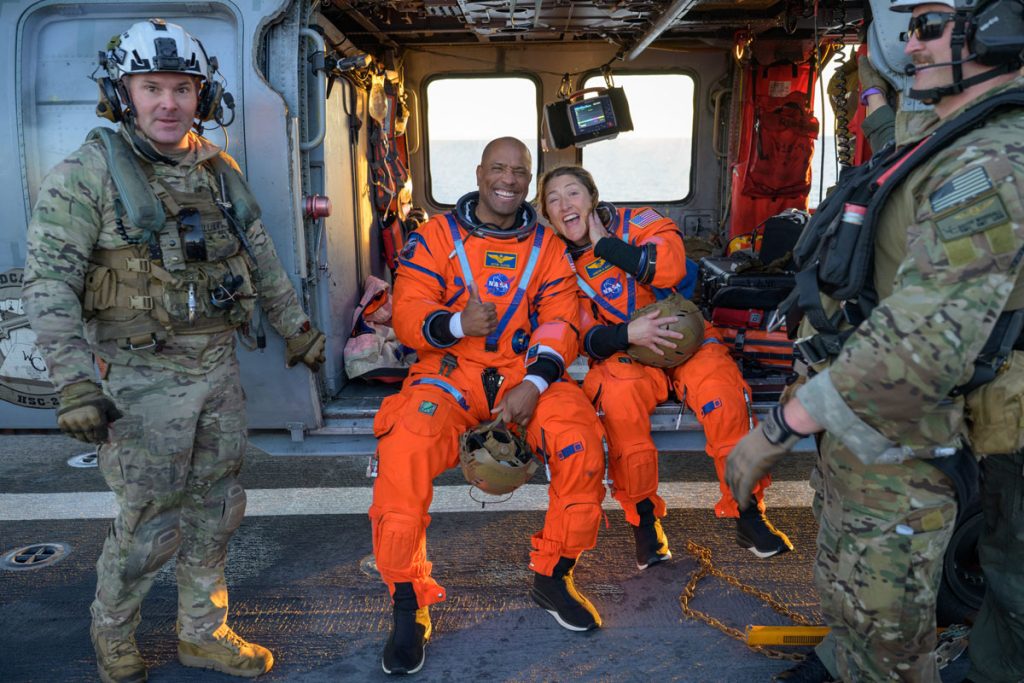
Four NASA astronauts and one from the Canadian Space Agency splashed down safely in the Pacific Ocean off San Diego late Friday, capping a flawless 10-day journey that marked humanity’s first crewed flight beyond low Earth orbit in more than half a century.
The Orion spacecraft, nicknamed ‘Integrity,’ touched the water at 8:07 PM EDT on April 10 after a high-speed plunge through Earth’s atmosphere, successfully concluding NASA’s Artemis II mission.
The crew, comprising Commander Reid Wiseman, Pilot Victor Glover, Mission Specialist Christina Koch, and Canadian Space Agency astronaut Jeremy Hansen, emerged under their own power, greeted by recovery teams aboard the USS John P. Murtha. Initial medical checks confirmed all four were in excellent health and high spirits following the voyage. By Saturday morning, they were en route back to NASA’s Johnson Space Center in Houston for further debriefings and reunions with family.
Launched aboard the powerful Space Launch System rocket from Kennedy Space Center on April 1, the mission took the astronauts on a looping trajectory around the Moon. On April 6, they flew past the lunar far side, out of radio contact with Earth for roughly 40 minutes, capturing unprecedented high-resolution views and breaking Apollo 13’s1970 distance record by reaching more than 252,000 miles from home.
The flight tested every major system of the Orion spacecraft and SLS in deep space, from life support to the heat shield that endured temperatures rivaling the surface of the Sun during Friday’s re-entry. Re-entry unfolded precisely as planned. The service module separated, a final trajectory correction burn refined the path, and Orion slammed into the atmosphere at nearly 25,000 mph. A six-minute communications blackout followed as a superheated plasma sheath formed around the capsule. Drogue parachutes deployed first, followed by the main chutes, slowing ‘Integrity’ to about 17 mph before the gentle upright splashdown. NASA officials described it as a perfect bull’s-eye.
Minor technical hiccups, such as a brief urine vent blockage and water system valve issues, were managed by the crew without impacting safety or objectives. Flight controllers praised the spacecraft’s performance as ‘thousands of times better’ than pre-flight simulations, with the heat shield emerging in far better condition than during the uncrewed Artemis I test in 2022.
NASA Administrator Jared Isaacman, who met the crew aboard the recovery ship, called the mission a pivotal step in America’s return to the Moon ‘to stay.’ Artemis program officials said the data gathered will directly inform Artemis III, targeted for a crewed lunar landing as early as 2027 or 2028, followed by more ambitious surface expeditions.
In post-splashdown remarks, the astronauts reflected on the mission’s deeper meaning. Mr. Wiseman spoke of the profound perspective the journey offered on Earth’s fragility, while Ms. Koch emphasized that pushing boundaries, despite the inconveniences and risks, remains essential for exploration. Mr. Hansen noted that no amount of ground testing can fully prepare a crew for the real thing.
With Artemis II now a part of history, NASA’s focus shifts squarely to preparing the next giant leap. The successful return has energized the agency and its international partners, proving that the hardware and teams are ready for the sustained lunar presence envisioned in the Artemis program.