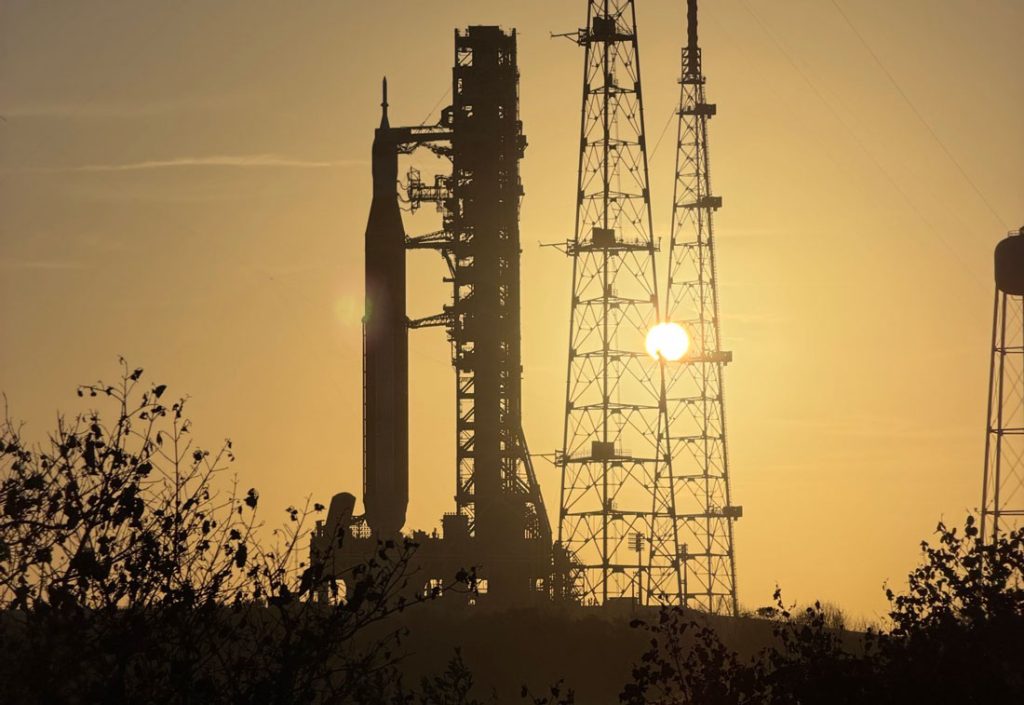
LATEST – NASA’s Artemis II roared off the Moon with a thundering success. Watch the take-off video below.
NASA’s Artemis II mission stands on the brink of liftoff, marking a pivotal return of humans to deep space more than five decades after the final Apollo flight.
Slated for no earlier than 6:24 p.m. EDT on Wednesday, April 1, 2026, from Launch Complex 39B at Kennedy Space Center in Florida, the roughly 10-day journey will send four astronauts on a lunar flyby aboard the Orion spacecraft atop the powerful Space Launch System (SLS) rocket. The international crew includes NASA astronauts Reid Wiseman (commander), Victor Glover (pilot), and Christina Koch (mission specialist), joined by Canadian Space Agency astronaut Jeremy Hansen (mission specialist).
This diverse team will test Orion’s life support systems with humans aboard for the first time, venture farther from Earth than any crewed mission in history, and gather valuable data on crew health and spacecraft performance during the free-return trajectory around the Moon.
Latest developments
As of April 1, final preparations are advancing smoothly. Teams have initiated propellant loading with super-cold liquid oxygen and hydrogen into the SLS rocket, following the activation of the countdown clock on Monday afternoon.
The astronauts arrived at the pad in the traditional Astrovan earlier today and are preparing to board the Orion capsule for final checks. Weather forecasts indicate an approximately 80% chance of favorable conditions for the two-hour launch window.
Backup opportunities extend through Monday, April 6, with another window possible around April 30 if needed. The mission profile calls for splashdown around April 10, assuming an on-time departure.
Overcoming technical hurdles
This launch attempt follows earlier setbacks. NASA originally eyed a February 2026 target, but engineers encountered hydrogen fuel leaks and a clogged helium pressurization line in the upper stage during pre-launch testing. The rocket was rolled back to the Vehicle Assembly Building for repairs and additional verification.
Issues identified after the uncrewed Artemis I flight, particularly with the Orion heat shield, prompted thorough analysis and fixes. Officials now report that these concerns have been resolved, clearing the path for the crewed test.
Artemis II
Artemis II builds directly on the success of Artemis I in 2022, which demonstrated the SLS and Orion’s capabilities without a crew. This flight will validate critical systems for future lunar landings, including those planned under subsequent Artemis missions that aim to establish a sustained human presence on and around the Moon.
Significance for space exploration
Beyond the technical milestones, Artemis II is also about international collaboration and the push toward long-term exploration goals, including eventual crewed landings and pathways to Mars.
The crew will conduct observations of the lunar surface and participate in scientific activities, such as capturing images and contributing to human health research in deep space. NASA is providing extensive live coverage across its channels, with tanking operations and countdown updates available throughout the day.
Public viewing at Kennedy Space Center Visitor Complex is limited for the initial dates due to the evening launch timing, but enthusiasts can follow from various coastal locations in Florida. As the final hours tick down, the mission represents not only a technological achievement but a symbolic step in humanity’s renewed commitment to exploring beyond low Earth orbit.