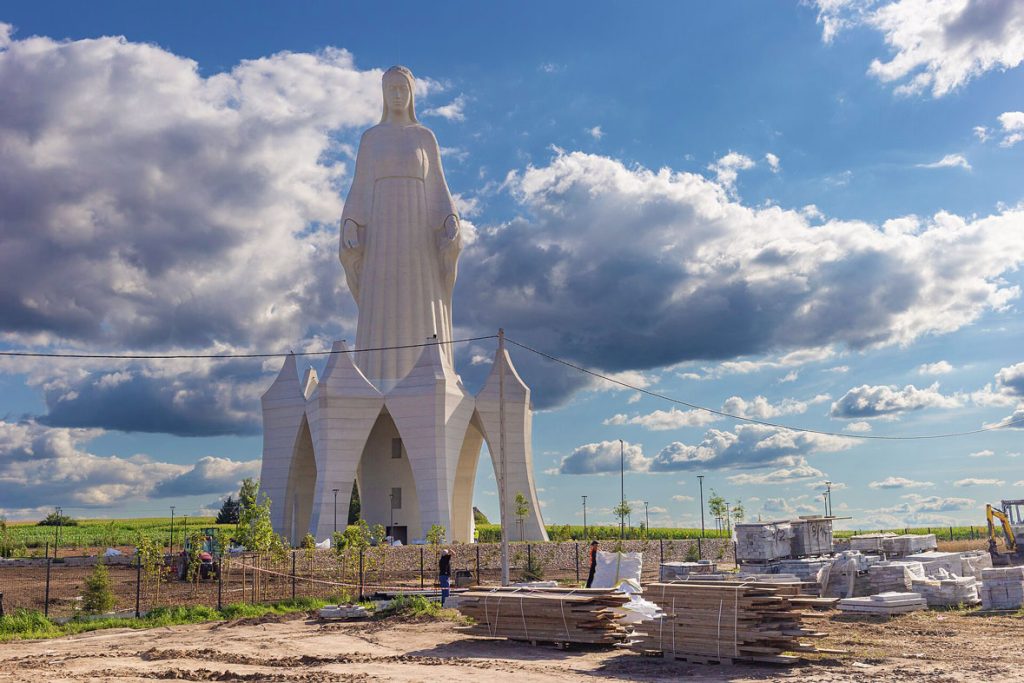
A towering 55.6-metre (182-foot) concrete and steel statue of the Virgin Mary, known as Our Lady of Mercy, was formally consecrated and opened to the public on 15 August 2026 in the small rural village of Konotopie in central Poland.
The monument is widely recognised as the tallest statue of the Virgin Mary in Europe and the tallest religious statue of any kind on the continent. The statue stands with open arms atop a crown-shaped pedestal measuring about 15 metres. The figure itself rises roughly 40.6 metres.
The statue’s total height exceeds that of Rio de Janeiro’s famous Christ the Redeemer (approximately 38 metres including its pedestal) and Poland’s own Christ the King statue in Świebodzin (52.5 metres including its mound). It remains shorter than the world’s tallest Virgin Mary statue, the 98-metre Mother of All Asia–Tower of Peace in the Philippines.
International attention
Konotopie, a village of fewer than 150 residents located roughly 100 miles northwest of Warsaw near Toruń, has suddenly gained national and international attention. The statue is visible from a considerable distance along the main road connecting Warsaw with northwestern Poland.
The statue was privately financed by local industrialist and investor Roman Karkosik and his wife Grażyna as a personal votive offering of gratitude for restored health and life.
Construction took about 18 months and is estimated to have cost around 100 million zloty (approximately €23 million). The project was designed by sculptor Adam Jakub Matejkowski.
The consecration ceremony, timed to coincide with the Catholic Feast of the Assumption of the Blessed Virgin Mary, was led by Bishop Krzysztof Wętkowski of the Diocese of Włocławek. Hundreds of people attended, including former Polish president and Solidarity leader Lech Wałęsa. Helicopters scattered rose petals over the crowd while priests celebrated Mass and the Mazowsze folk ensemble performed traditional music.
In his homily, Bishop Wętkowski described the statue as a call for people to ‘raise our gaze upwards to God and heaven,’ noting that many focus only on earthly matters. He emphasised that the site, already home to a nearby chapel dedicated to Our Lady of Sorrows that has long attracted local pilgrims, is now intended as a place of prayer.
Visitors can climb to a viewing terrace inside the crown-shaped base for panoramic views of the surrounding fields, lakes and forests. Local residents and organisers hope the landmark will draw pilgrims and tourists, potentially transforming the quiet agricultural area into a destination.