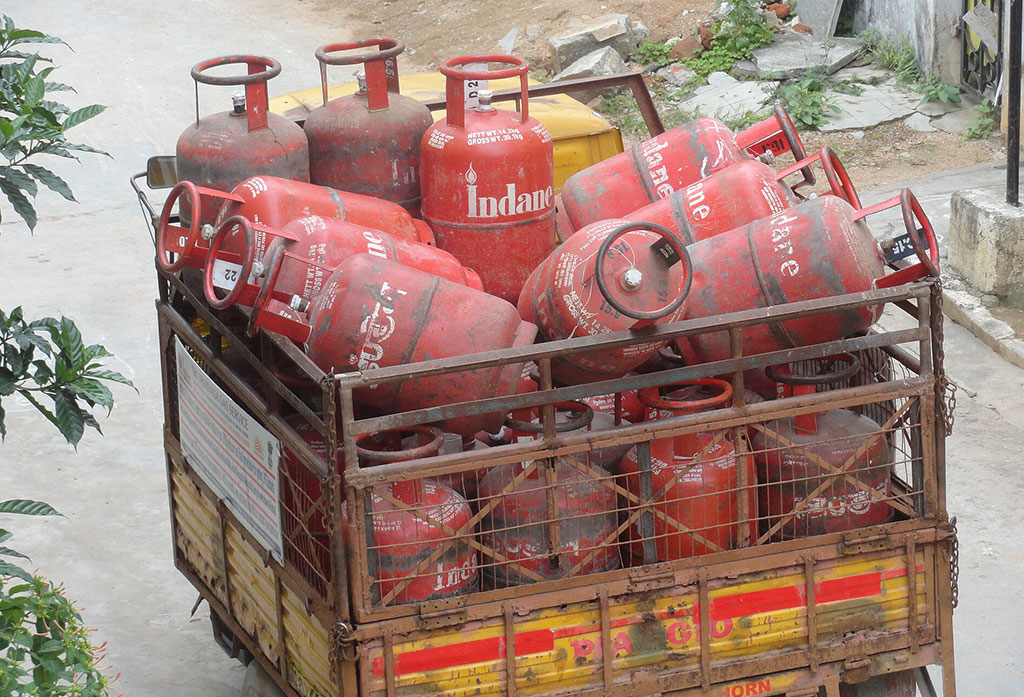
As the US-Israel conflict with Iran enters its fifth week in early April 2026, India is managing ripple effects on liquefied petroleum gas (LPG) supplies, the fuel that powers cooking in more than 300 million households nationwide.
While the government maintains there is no nationwide shortage of domestic LPG and sufficient buffer stocks, the commercial sector, including restaurants, hotels, and small industries, is experiencing real constraints, with rationing, delayed deliveries, and localized queues reported in major cities.
The trigger is the effective closure or severe disruption of the Strait of Hormuz, the narrow Gulf chokepoint through which roughly 90% of India’s LPG imports normally pass. India meets about 60% of its total LPG demand through imports, and the Middle East has historically supplied the bulk of those shipments.
March 2026 saw imports plunge by nearly 46-50% compared to February on a daily basis, according to ship-tracking data and trader estimates, as dozens of vessels remained stalled.
Government response: Prioritisation and diversification
The Ministry of Petroleum and Natural Gas has repeatedly assured the public that domestic LPG supplies remain stable.
Refiners have ramped up local production by up to 40%, but still reached around 50,000 metric tonnes per day againstnormal consumption of roughly 80,000-90,000 tonnes.
Emergency powers were invoked in early March to direct oil companies to boost output and prioritise household cylinders, hospitals, and essential services.
Several relief cargoes have reached Indian ports in recent days. Tankers such as BW TYR (arriving Mumbai around March 31) and BW ELM (heading to New Mangalore by April 1), along with others like Shivalik and Nanda Devi, have delivered nearly 187,000 metric tonnes combined, equivalent to millions of domestic cylinders.
India has also sourced LPG from alternative markets, including the United States, Russia, Argentina, and even secured one Iranian cargo under a temporary US sanctions waiver, the first such purchase in years.
Officials are also accelerating the shift to piped natural gas (PNG). Cities like Noida and Ghaziabad have seen a surge in domestic PNG applications, over 4,000 and 5,000 respectively, since early March, as consumers seek long-term alternatives.
Where the impact is being felt
Despite official assurances, the squeeze is visible in the commercial segment:
- Restaurants and hotels in Bengaluru, Mumbai, Chennai, Goa, Prayagraj, and Patna are limiting operating hours, trimming menus, or switching to induction cooktops and wood-fired stoves. Some banquet halls have raisedcatering prices due to higher costs or supply uncertainty.
- Long queues and hoarding have been reported at distributors in several states, prompting enforcement drives that seized thousands of cylinders. Panic buying spiked in mid-to-late March but has eased slightly with new arrivals.
- Price adjustments: Commercial LPG cylinder prices were hiked in late March following global benchmark surges, adding pressure on eateries and small businesses.
Domestic household users, however, continue to receive subsidised refills with minimal disruption, thanks to strict prioritisation. The government has emphasised that current stocks can cover normal demand for several weeks while alternative supplies are secured.
Broader outlook
India consumed about 31.3 million metric tonnes of LPG in the previous financial year, with households accounting for nearly 87% of use. The crisis has renewed focus on reducing import dependence through domestic exploration, renewable energy, and expanded PNG infrastructure.
As of April 1, 2026, the situation remains fluid. Foreign Minister S Jaishankar has indicated diplomatic efforts to ease Hormuz disruptions, while energy officials continue monitoring shipments.
Experts say the worst of the immediate crunch may have passed with recent deliveries, but sustained peace in the Gulf will be needed for full normalisation. For now, the message from authorities is clear – cook judiciously, avoid hoarding, and consider switching to piped gas where available.