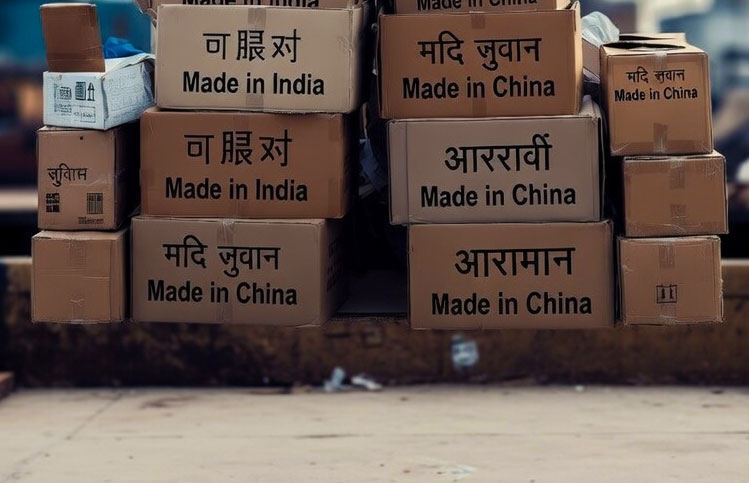
China has reclaimed its position as India’s biggest trading partner in the ongoing financial year, overtaking the United States after the latter held the top spot for four consecutive years.
Official figures for April to February 2025-26 show bilateral merchandise trade between India and China reaching $137 billion, ahead of the $127.8 billion recorded with the US during the same period. The development was spotlighted by Chinese Ambassador to India Xu Feihong, who posted on social media that Beijing had maintained the lead for 11 straight months. ‘Glad to know that China has become India’s largest trading partner in FY2026 — for the 11th straight month,’ he wrote, citing the latest commerce data from both sides.
The milestone reflects a broader momentum in economic ties that began accelerating in calendar year 2025. Full-year bilateral trade between the two neighbours then climbed to a record $155.6 billion, marking a 12 per cent jump year-on-year. India’s exports to China rose 9.7 per cent to $19.75 billion, even as Chinese shipments to India grew faster at 12.8 per cent.
This rebound follows years of strained relations after the 2020 Galwan Valley clashes. Diplomatic and military disengagement completed in late 2024 has since paved the way for normalised people-to-people contacts, including resumed flights, visas, and pilgrimages. Trade officials on both sides have described the recent figures as evidence of pragmatic economic cooperation amid global uncertainties, including shifting supply chains and tariff pressures from major Western economies.
Sector-wise, China continues to dominate India’s imports of critical inputs, electronics components, machinery, active pharmaceutical ingredients, and intermediate goods, where domestic alternatives remain limited despite New Delhi’s’Atmanirbhar Bharat’ and ‘China-plus-one’ diversification drives.
Indian shipments to China, meanwhile, have gained traction in pharmaceuticals, iron ore, and certain agricultural products, though the overall trade balance remains heavily tilted in Beijing’s favour. The deficit touched a record $116 billion in calendar 2025. Indian government data for April-February 2025-26 further corroborates the trend. Exports to China posted the strongest growth among top destinations at 37.66 per cent, while imports from China rose 15.21 per cent.
The United States, by contrast, remained India’s largest export market overall but lagged in combined two-way trade volume during the period under review. Economists view the shift as more structural than temporary. While India has successfully expanded trade with the US, UAE, and ASEAN in recent years, China’s manufacturing scale and proximity continue to make it an indispensable partner for cost-sensitive imports.
The development is also occurring against a backdrop of improving high-level engagement, including alignment on multilateral forums such as BRICS. Yet challenges persist. Indian policymakers continue to scrutinise sensitive technology transfers and have imposed anti-dumping duties on select Chinese products. Beijing, for its part, has expressed willingness to address market-access concerns for Indian agricultural and pharmaceutical exports.
As the final month of FY 2025-26 unfolds, analysts expect the full-year figures to reinforce China’s lead, potentially widening the gap further if current monthly trends hold. The episode underscores a central reality in India-China relations. Even as strategic competition remains, economic interdependence is deepening in ways that neither side can easily unwind.