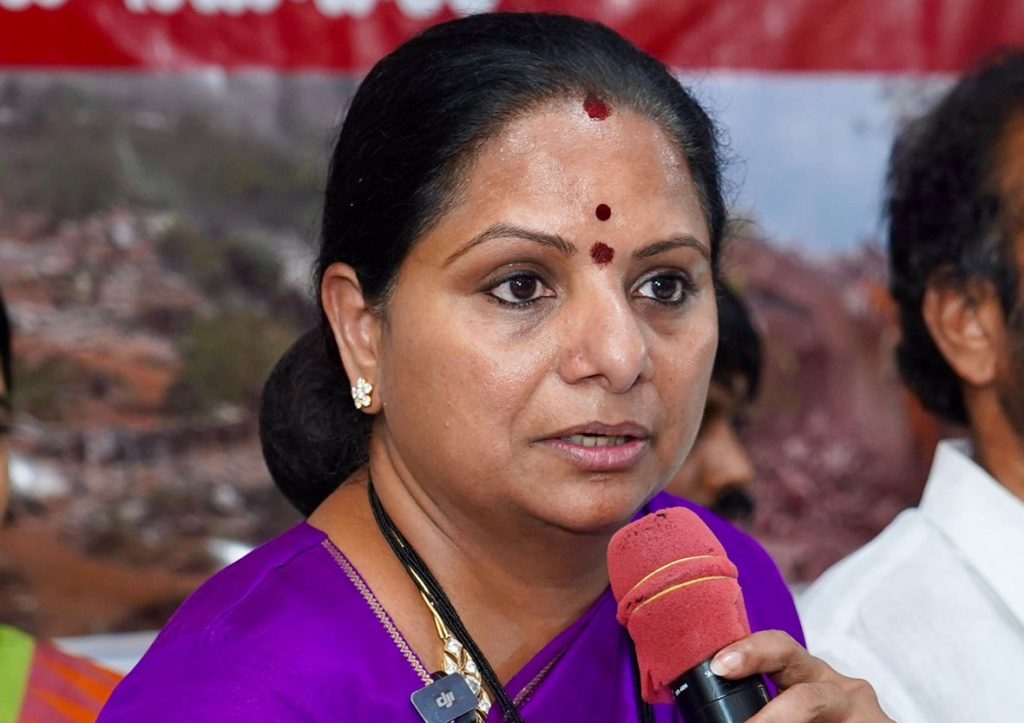
In a move that highlighted the deepened fissures within Telangana’s first family of politics, Kalvakuntla Kavitha, daughter of Bharat Rashtra Samithi (BRS) founder and former Chief Minister K. Chandrashekar Rao, has formally announced the launch of her own political party on April 25, 2026.
Speaking at a press conference in Nizamabad on March 27, the former Nizamabad MP and Telangana Jagruthi president declared that the new outfit, to be unveiled at Advaya Conventions in Medchal near Hyderabad, will mark ‘the beginning of a new era in Telangana politics.’
Positioned explicitly as a Telangana-centric force, the party is expected to emphasize inclusive welfare, self-sufficiency, and the ‘Telangana First’ mantra, drawing on the organizational backbone of her existing Telangana Jagruthi platform.
This development is no sudden impulse but the culmination of a very public family and ideological rupture that began in earnest in September 2025. Kavitha, once a key BRS face and MLC, was suspended by her father for anti-party activities after openly criticizing her cousin T. Harish Rao and other senior leaders for what she described as internal mismanagement and a drift from core Telangana aspirations.
She resigned from her legislative post and distanced herself from the BRS. The split with her father KCR and brother KT Rama Rao (KTR) now appears irreversible, with Kavitha framing her exit as a principled stand against dynastic complacency rather than personal ambition.
At its core, Kavitha’s vision seeks to reclaim the ‘Telangana self-respect’ narrative that propelled her father’s original Telangana Rashtra Samithi to power in 2014. She has repeatedly criticized the BRS for losing its regional focus after going national, the Congress for alleged governance lapses, and the BJP for what she calls overreach from Delhi.
The new party, hinted at as ‘Sarvodaya Telangana’ or an evolution of ‘Telangana Praja Jagruthi’ will prioritize youth empowerment, women’s leadership, and welfare schemes that cut across caste and class lines, positioning itself as the only truly regional alternative untainted by national alliances.
Ms. Kavitha has also hinted at contesting from high-profile seats like Siddipet (her cousin Harish Rao’s stronghold and her father’s former turf) or Bodhan, signaling an aggressive bid to carve out BRS loyalists disillusioned with the family leadership.
From a strategic standpoint, the timing is astute yet high-stakes. With the next Assembly polls still three years away (likely 2029), Kavitha gains a crucial runway to build cadre, secure funding, and craft a distinct identity. Her consultations with political strategist Prashant Kishor and the recent discharge in the Delhi liquor policy case have cleared personal and legal hurdles, allowing her to project a clean, forward-looking image.
The ‘Telangana Adabidda’ (Telangana’s daughter) branding taps into emotional regionalism and gender symbolism in a state where women voters have grown increasingly influential. Grassroots work through Telangana Jagruthi over the past year has already created pockets of support, particularly among women and backward classes who feel sidelined by the Congress government’s performance and the BRS’s internal chaos.
Yet the challenges are formidable and could define whether this becomes a transformative force or a footnote in Telangana’s volatile politics. New parties in India rarely succeed without deep organizational roots or massive resources, and Kavitha enters a crowded field – a ruling Congress seeking to consolidate its base, a diminished but still relevant BRS clinging to its KCR legacy, and a resurgent BJP eyeing southern expansion.
The most immediate risk is vote fragmentation. Her entry could split the anti-Congress regional vote, inadvertently benefiting the incumbent party she criticizes.
Funding transparency, alliance possibilities (she has ruled out joining Congress or aligning blindly with national players), and proving independence from the KCR shadow will test her credibility. Critics may dismiss the move as dynastic rebellion rather than genuine reform, especially given her reliance on the family name for initial visibility.
Politically, the ripple effects could be profound. For the BRS, Kavitha’s departure accelerates its post-2023 decline, potentially forcing a leadership rethink or further defections. Congress may quietly welcome the split as it weakens its primary regional rival without direct confrontation. The BJP, meanwhile, could find tactical openings if Kavitha’s ‘non-Congress, non-BJP’ stance evolves into selective cooperation.
Symbolically, a woman-led regional party in a state born from a mass movement offers a fresh narrative of empowerment, one that could inspire younger voters tired of male-dominated family fiefdoms.
Ms. Kavitha’s bold pivot represents both opportunity and uncertainty for Telangana’s political ecosystem. It injects fresh energy into a landscape dominated by incumbency fatigue and family legacies, but success hinges on executio.
As April 25 approaches, the launch will not merely unveil a new flag but test whether personal ambition can evolve into a genuine people’s movement. In a state still grappling with identity, development, and power transitions, Kavitha’s experiment could either redefine regionalism or highlight the limits of breaking free from entrenched dynasties.