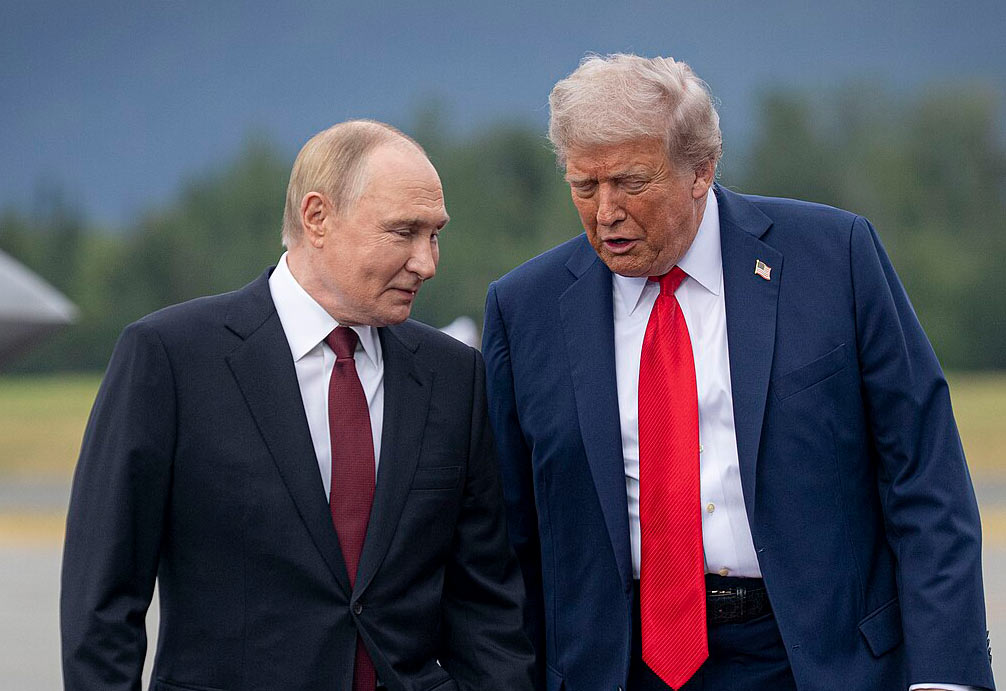
The Russia-Ukraine war, now in its fourth year, remains a focal point of global diplomacy as recent high-level talks between US President Donald Trump and Russian President Vladimir Putin concluded without a ceasefire agreement.
Ukrainian President Volodymyr Zelenskyy is now set to meet Trump in Washington on Monday to discuss paths toward ending the conflict, which continues to claim lives.
Trump – Putin Meeting
On August 15, 2025, Mr. Trump and Mr. Putin met in Anchorage, Alaska, for a nearly three-hour summit aimed at addressing the ongoing war.
The meeting, held at Joint Base Elmendorf-Richardson, marked the Russian leader’s first US visit in a decade and was notable for its symbolic weight, given Alaska’s historical ties to Russia.
Despite a cordial tone, no concrete progress was made toward halting hostilities. President Trump described the talks as very successful, while President Putin called them frank and meaningful, yet both leaders acknowledged that no deal was reached.
Mr Putin reportedly demanded Ukraine cede control of Donetsk and Luhansk provinces as a condition for peace, a proposal that aligns with Russia’s long-standing push for territorial concessions.
The next meeting between the leaders of the US and Russia could actually be held in Moscow, as the latter country’s leader proposed it in front of the press, and the leader of the former nation pondered over it.
A notable point from the Alaska summit was a handwritten letter from First Lady Melania Trump, delivered by Trump to Putin, addressing the plight of Ukrainian children forcibly displaced by Russia, a crime for which the Russian leader faces an International Criminal Court warrant. The letter, read immediately by Putin in front of delegates, underscores growing international concern over this issue.
Zelenskyy frustrated with progress (or the lack of it)
Ukrainian President Zelenskyy, who was not invited to the Alaska summit, expressed frustration over Russia’s continued rejection of ceasefire calls, noting that Moscow ‘has not yet determined when it will stop the killing.’
In a post on X, he emphasized the need for a ‘real peace’ that ensures lasting security, not just a temporary pause in fighting. His upcoming Washington visit, confirmed after a phone call with Mr. Trump and European leaders on Saturday, is seen as a critical opportunity to assert Ukraine’s position in negotiations. Mr. Zelenskyy has stressed the importance of European involvement in any peace process, advocating for ‘ironclad security guarantees’ to deter future Russian aggression.
As Mr. Zelenskyy prepares for his Washington trip, the absence of a trilateral meeting involving Russia remains a sticking point. Putin’s advisor, Yuri Ushakov, indicated that a three-way summit ‘has not been touched upon’ in US-Russia discussions. Mr. Zelenskyy, however, supports the idea, provided it includes robust security guarantees. The outcome of Monday’s talks could shape the war’s trajectory, with Ukraine and its allies pushing for a resolution that preserves its territorial integrity against Russia’s demands.
European leaders and their dilemma
US President Trump’s stance has raised concerns among Ukraine’s allies. Initially pushing for a ceasefire as a prerequisite for peace talks, Mr. Trump shifted his rhetoric post-summit, advocating for a direct ‘Peace Agreement’ without a prior halt in fighting—a position closer to Putin’s.
Sources close to the Alaska meeting suggest President Trump may have endorsed territorial concessions, including control of Donetsk, Luhansk, and Crimea, as a means to end the war. This has sparked fears among analysts that Mr. Trump’s approach could pressure Ukraine into compromising its sovereignty.
Olga Tokariuk of the Center for European Policy Analysis called the summit a ‘propaganda win’ for Russia, citing the warm reception Mr. Putin received.
European leaders, wary of being sidelined, have rallied behind Mr. Zelenskyy. French President Emmanuel Macron, German Chancellor Friedrich Merz, and UK Prime Minister Keir Starmer are hosting a virtual ‘coalition of the willing’ meeting on Sunday to discuss support for Ukraine, including potential troop deployments to deter Russia post-conflict. European statements have avoided directly contradicting President Trump but emphasize that Ukraine must decide its own future, with ‘no limitations’ on its path to NATO or EU membership.
Meanwhile, on the battlefront…
On the battlefield, Ukraine reported pushing Russian forces back by approximately 1.2 miles on the Sumy front in northern Ukraine, near the Russian border. The Ukrainian general staff highlighted ongoing combat near Oleksiivka and Yunakivka, underscoring the intensity of the conflict along the 1,000-kilometer front line. Russian forces, meanwhile, have accelerated territorial gains since spring, capturing significant ground.
Ukraine’s air defenses say they repelled 59 of 71 Russian drones launched overnight on August 10, though Russian attacks continue to target eastern regions.
The international community is watching closely as diplomatic efforts intensify, but the lack of progress in Alaska and ongoing military escalation suggest that a resolution remains elusive.