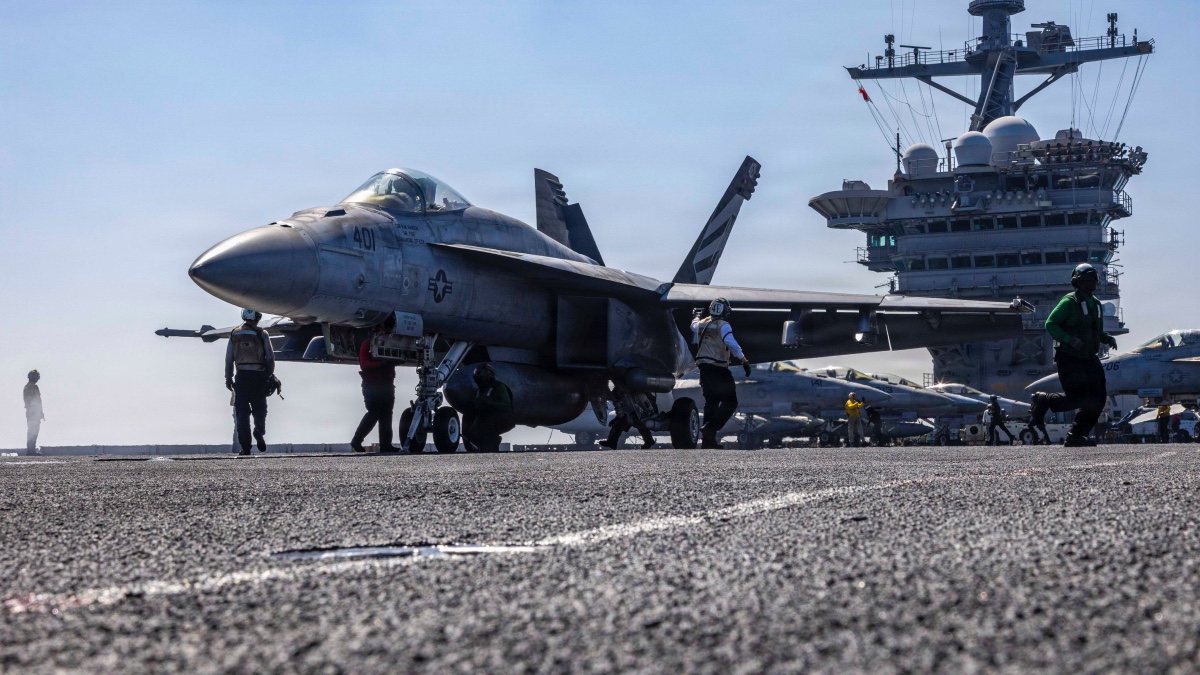
In a display of military synchronization rarely seen between the two nations, the United States and Israel have established near-total dominance over Iranian airspace, pounding command centers, missile batteries, and naval assets for a fifth straight day while Iranian retaliation ripples across the Persian Gulf and into Lebanon.
The campaign, launched on February 28 with a barrage of missiles, fighter jets, drones, and cyberattacks, has already dismantled much of Iran’s air defense network, sunk nearly 20 warships, one recently in the Indian Ocean near Sri Lanka, and eliminated key figures at the pinnacle of Tehran’s power structure.
President Donald Trump declared Tuesday that Iran’s air defenses, air force, navy, and senior leadership were effectively ‘gone,’ adding that the US military had delivered ‘a very powerful impact’ and that ‘virtually everything they had has been knocked out now.’
The operation, dubbed Operation Epic Fury by the Pentagon and Roaring Lion by the Israel Defense Forces, began with precision strikes that killed Supreme Leader Ayatollah Ali Khamenei at his Tehran compound, along with dozens of senior Revolutionary Guards commanders, defense officials, and family members.
Iranian state media and a few human-rights monitors put the death toll inside Iran at more than 1,045, including hundreds of civilians and at least 176 children, in strikes on schools and residential areas.
Iran responded with Operation True Promise IV, unleashing waves of ballistic missiles and drones that struck US bases in Kuwait (killing six American service members), the US embassy compound in Riyadh, civilian districts in Dubai and Doha, and Israeli cities. Hezbollah, Tehran’s Lebanese proxy, opened a second front, firing rockets into northern Israel and prompting Israeli ground incursions and airstrikes around Beirut.
The Strait of Hormuz, through which roughly one-fifth of global oil passes, has been partially closed by Iran, sending crude prices surging above $80 a barrel and rattling stock markets from New York to Tokyo.
What sets this conflict apart is the depth of US-Israeli integration. American and Israeli officers are coordinating up to 5,000 times a day, carving up Iranian airspace so that Israeli jets focus on western and central targets while US forces hammer the south.
Defense Secretary Pete Hegseth described the partnership as ‘a true force multiplier and a breath of fresh air,’ with hundreds of US troops already embedded in Israel operating THAAD batteries and logistics hubs.
Pentagon briefings on Tuesday indicated that ‘complete control’ of Iranian skies could be achieved within days, allowing lower-altitude precision strikes without fear of retaliation. Israeli officials say their target list is being cleared faster than anticipated; the campaign was originally planned for two weeks, but is accelerating.
US President Trump has floated a timeline of four to five weeks, while insisting the United States is prepared to fight ‘far longer,’ and has offered US Navy escorts and maritime insurance to keep Gulf oil flowing. Yet behind the confident rhetoric lie shifting justifications.
Initial statements emphasized regime change and freeing the Iranian people; more recent comments focus narrowly on neutralizing nuclear and missile threats. Secret indirect outreach from Iranian intelligence operatives, relayed through a third country, suggests elements in Tehran are already probing for an off-ramp, though Trump has dismissed early talks as ‘too late.’
The human and strategic stakes are immense.
Gulf states that once quietly urged restraint now find themselves under direct Iranian fire, with civilian airports closed, luxury hotels damaged, and foreign workers fleeing. Europe has mobilized naval assets to protect Cyprus after an Iranian drone struck a British base there.
The United Nations has condemned the initial strikes as unlawful and called for immediate de-escalation, but veto threats in the Security Council have so far blocked meaningful action.
For Israel, the campaign fulfills a long-standing strategic imperative: eliminating an existential nuclear and missile threat from a regime that has vowed its destruction for nearly five decades. For the Trump administration, it represents a high-stakes bet that decisive force can reshape the Middle East without bogging the United States down in another endless war.
Yet the speed of Iran’s leadership decapitation has created a dangerous power vacuum. An interim council has formed, but with the Assembly of Experts building in Qom bombed and succession lines shattered, the risk of fragmented militias or chaotic infighting looms large. Kurdish groups inside Iran have already signaled readiness to exploit the chaos.
As explosions continue to light up Tehran’s skyline and air-raid sirens wail from Tel Aviv to Doha, one fact is undeniable: the world’s most volatile region has entered uncharted territory. What began as a preemptive strike to avert a nuclear Iran has become a widening war whose endgame, whether swift regime collapse, prolonged attrition, or a fragile negotiated pause, will define global security for years to come.