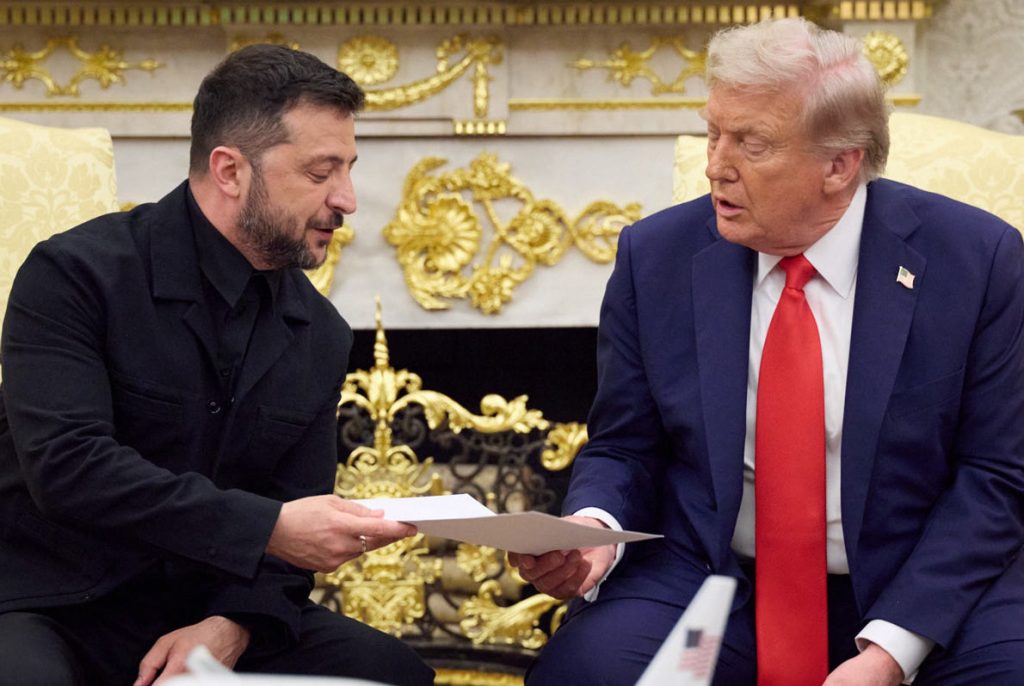
US President Donald Trump met Ukrainian President Volodymyr Zelenskyy and a coalition of European leaders at the White House on Monday to broker peace in the ongoing Russia-Ukraine conflict.
The meeting, described by Mr. Trump as a ‘very good, early step,’ comes just days after his summit with Russian President Vladimir Putin in Alaska, where discussions failed to yield an immediate ceasefire.
With the war entering its fourth year, the stakes are high as world leaders grapple with finding a lasting solution. The White House gathering featured an impressive lineup of international figures, including British Prime Minister Keir Starmer, French President Emmanuel Macron, German Chancellor Friedrich Merz, Italian Prime Minister Giorgia Meloni, NATO Secretary General Mark Rutte, European Commission President Ursula von der Leyen, and Finnish President Alexander Stubb.
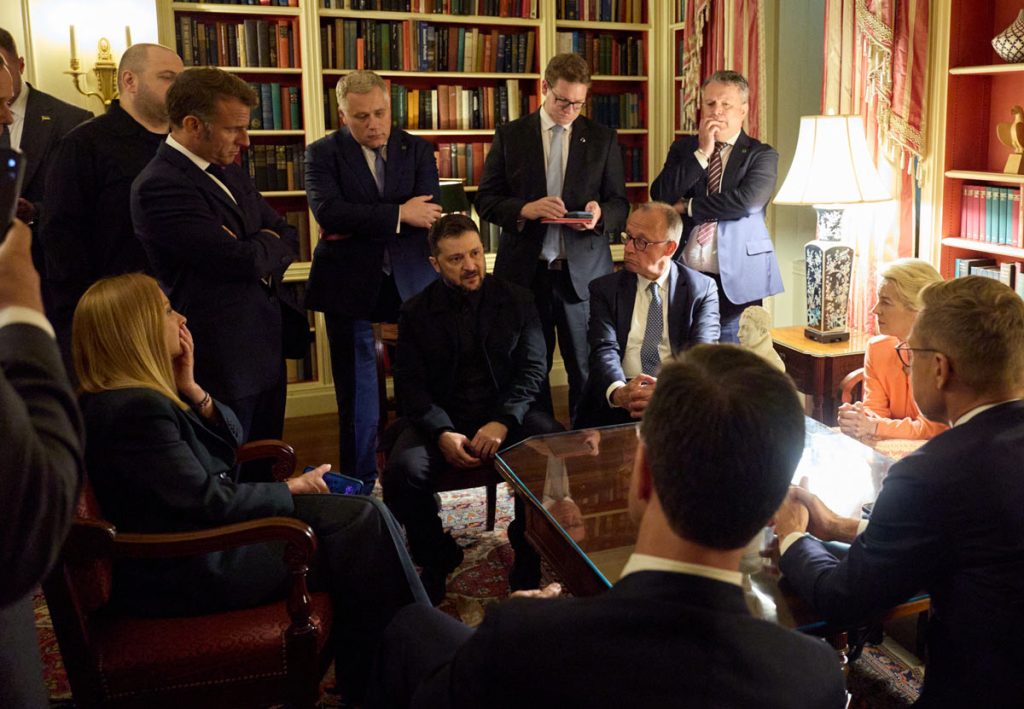
The unprecedented assembly of leaders showed a collective effort to support Ukraine while addressing US President Trump’s proposal for a trilateral summit involving himself, Zelenskyy, and Putin. Following the meeting, Mr. Trump announced he had spoken with Putin by phone, initiating plans for a bilateral meeting between the Russian and Ukrainian leaders, to be followed by a three-way discussion.
Ukrainian President Zelenskyy, who arrived in a tailored black suit, a departure from his usual military attire, expressed optimism about the talks, calling them constructive and highlighting discussions on battlefield updates and security guarantees. He revealed plans for Ukraine to purchase $90 billion in American weapons, funded through European channels, as part of a broader security framework.
European leaders echoed the need for robust guarantees to protect Ukraine from future Russian aggression, with Mr. Macron cautioning that Mr. Putin’s ultimate goal appears to be territorial expansion rather than peace.
However, the meeting’s impact remains uncertain.
President Trump’s shift away from demanding an immediate ceasefire, previously a cornerstone of his approach, has raised eyebrows. Instead, he suggested that negotiations could proceed amid ongoing fighting, a stance that contrasts with Ukraine’s long-standing call for a halt to hostilities before talks. Mr. Zelenskyy has consistently rejected ceding territory, a demand that Russia has tied to any peace deal, complicating the path forward.
European allies, while supportive, emphasized that any agreement must respect Ukraine’s sovereignty, a point Starmer reinforced by insisting that ‘no decision should be made about Ukraine without Ukraine.’
Analysts are divided on the meeting’s potential to yield results in the coming days. Some see Mr. Trump’s direct engagement with Mr. Putin as a potential breakthrough, given his reported rapport with the Russian leader. Others warn that without a ceasefire or concrete concessions, the talks risk stalling, especially as Russia continues its military operations, with recent attacks in Kharkiv claiming seven lives.
The proposed Zelenskyy-Putin meeting, with no confirmed date or location, adds to the uncertainty, as does Mr. Putin’s historical reluctance to negotiate directly with Zelenskyy.
Ukrainian leader Zelenskyy indicated that security guarantees might be formalized within 10 days. Yet, with deep-seated distrust between Russia and Ukraine, and differing visions for peace, real progress may require much more than a single summit.