Hopes for a breakthrough in the grinding Ukraine conflict dimmed Tuesday as the White House shelved plans for a high-stakes summit between President Donald Trump and Russian President Vladimir Putin in Budapest, Hungary.
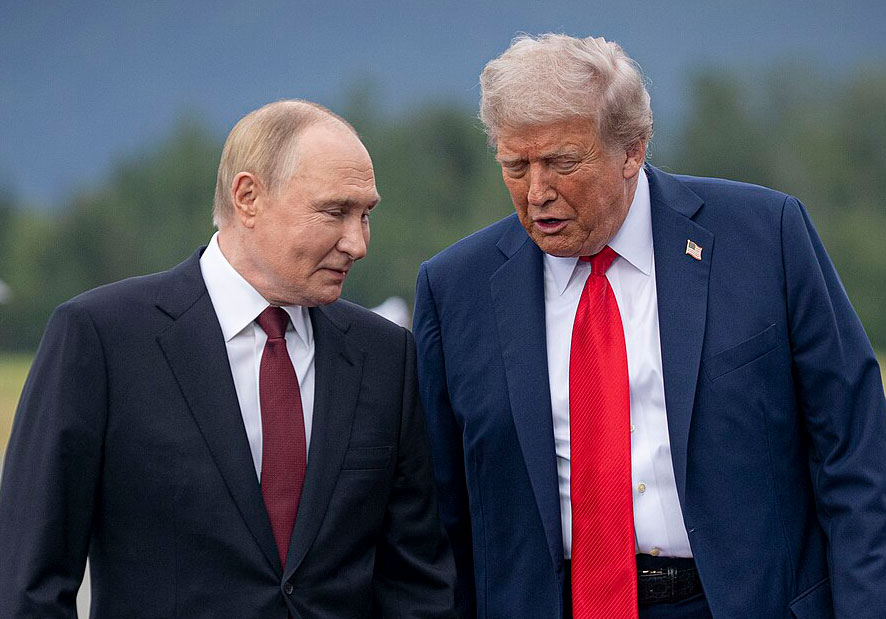
The abrupt postponement, announced just days after Mr. Trump touted the meeting as imminent, stems from irreconcilable differences over ceasefire terms, with Moscow rejecting US proposals to halt fighting along current front lines.
The latest development marks another setback for the US President’s aggressive push to broker peace, raising questions about the viability of direct talks amid escalating battlefield pressures and transatlantic tensions.
The summit had been fast-tracked following a two-hour phone call between Trump and Putin on October 16, where the leaders reportedly made ‘great progress’ toward negotiations. Mr. Trump, speaking to reporters aboard Air Force One that day, even predicted the face-to-face would occur ‘within two weeks or so, pretty quick,’ framing it as a sequel to their August 15 gathering in Anchorage, Alaska. That earlier encounter, held at Joint Base Elmendorf-Richardson, yielded no tangible advances but set the stage for further dialogue on ending the nearly four-year war.
Budapest emerged as the venue partly due to Hungarian Prime Minister Viktor Orbán’s role as a neutral broker, though his pro-Moscow leanings drew sharp rebukes from Kyiv and EU capitals, who viewed the choice as symbolically fraught given Hungary’s vetoes on Ukraine aid packages.
Preparations unraveled swiftly. A planned in-person huddle between US Secretary of State Marco Rubio and Russian Foreign Minister Sergey Lavrov, slated for Budapest on Thursday to iron out logistics, morphed into a tense Mondayphone call that exposed deep rifts.
According to White House officials, Mr. Lavrov conveyed Russia’s refusal to accept a temporary freeze of hostilities or territorial status quo, insisting instead on full control over annexed regions like Donetsk and Luhansk as non-negotiable preconditions. ‘Secretary Rubio and Foreign Minister Lavrov had a productive call,’ a senior administration figure told reporters on condition of anonymity. ‘Therefore, an additional in-person meeting… is not necessary, and there are no plans for President Trump to meet with President Putin in the immediate future.’
President Trump, addressing the snag during an Oval Office press availability, struck a pragmatic tone. ‘I don’t want to have a waste of time,’ he said, adding that any future parley must yield ‘real results’ rather than posturing. The pivot echoes his recent about-face on Ukraine’s territorial claims: Last month, Trump suggested Kyiv could reclaim all lost lands, but post-call with Putin and after a frosty October 17 White House lunch with Ukrainian President Volodymyr Zelenskyy, he advocated a ‘cut and stop at the battle line’ approach, rebuffing Moscow’s maximalist demands while denying Zelenskyy’s plea for long-range Tomahawk missiles.
Kremlin spokesman Dmitry Peskov, meanwhile, downplayed the drama, noting no firm date had ever been locked in. Mr. Lavrov, for his part, dismissed Western media reports of cancellation as unscrupulous fabrications aimed at derailing progress.
The snag reverberates beyond bilateral channels. Ukrainian leader Zelenskyy, in a pointed Telegram post Tuesday, accused the Russian President of tactical gamesmanship. ‘As soon as the pressure eased a little, the Russians began to try to drop diplomacy, postpone the dialogue,’ he said.
He reiterated openness to joining any Trump-Putin talks, provided they exclude concessions on sovereignty. European allies, wary of Mr. Orbán’s influence, breathed quiet relief at the delay. A coalition of 35 Ukraine-backing nations, dubbed the ‘Coalition of the Willing,’ convened in London Friday to hash out a 12-point peace blueprint inspired by Mr. Trump’s Gaza framework, emphasizing economic sanctions to squeeze Russia’s war machine until Moscow bends. ‘We must ramp up the pressure on Russia’s economy and its defense industry,’ the group stated, signaling no tolerance for half-measures.