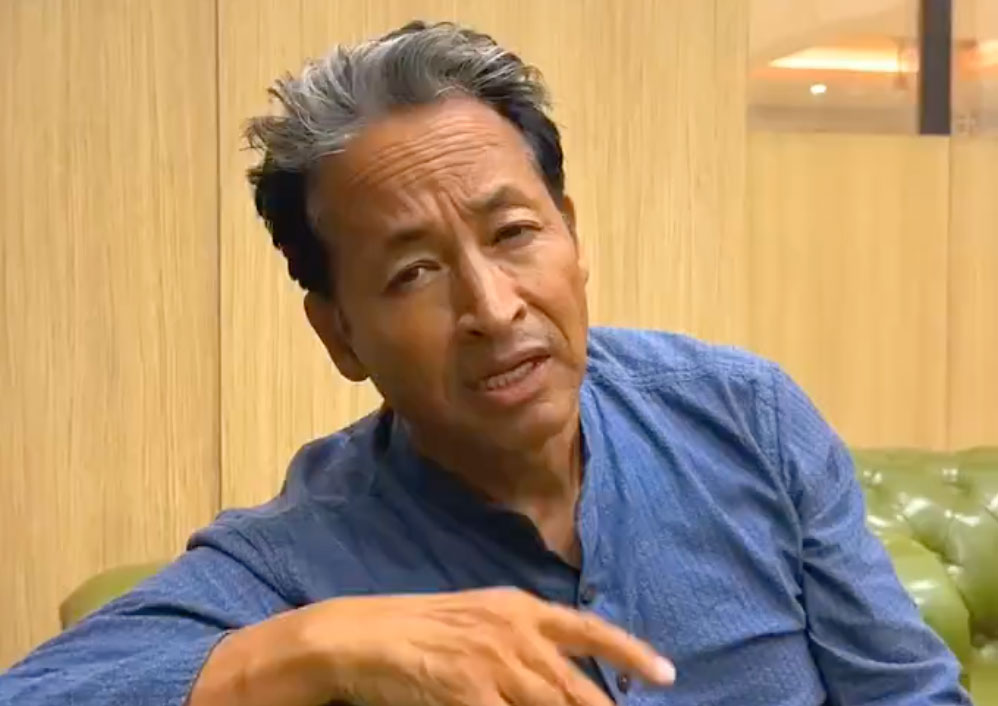
In a renewed push for constitutional autonomy, the Leh Apex Body (LAB) and Kargil Democratic Alliance (KDA) have handed over a detailed 29-page blueprint to the Union Home Ministry, explicitly calling for the unconditional release of renowned climate activist Sonam Wangchuk as a prerequisite for advancing dialogue on Ladakh’s future.
The submission, formalized on November 17 and further elaborated in meetings through November 20, arrives amid simmering tensions over the union territory’s governance, just days before a pivotal Supreme Court hearing on Wangchuk’s detention.
Mr. Wangchuk, the 58-year-old engineer behind the innovative ‘ice stupa’ water conservation project and founder of the Students’ Educational and Cultural Movement of Ladakh (SECMOL), has been languishing in Jodhpur Central Jail since his September 26 arrest under the stringent National Security Act (NSA). The detention stemmed from his leadership in a 35-day hunger strike that culminated in the deadly September 24 clashes in Leh, where four protesters lost their lives, nearly 100 were injured, and public property, including a BJP office and police vehicles, was torched.
Authorities pinned the unrest on Mr. Wangchuk, alleging he incited crowds during demonstrations demanding safeguards against demographic shifts and resource exploitation post the 2019 abrogation of Article 370, which stripped Jammu and Kashmir of its special status and carved out Ladakh as a separate entity.
The draft proposal, spearheaded by LAB co-chairman Chering Dorjay Lakruk and KDA convenor Qamar Ali Akhoon, outlines a roadmap to restore trust – full statehood with a 30-member legislative assembly, extension of the Sixth Schedule for tribal area protections, and incorporation under Article 371 for enhanced local governance. It proposes replacing the current Ladakh Autonomous Hill Development Councils with more empowered bodies, akin to Nagaland’s Article 371A model, to shield indigenous Buddhist and Muslim communities from external encroachments.
The proposal also insists on a blanket amnesty for all 200-plus individuals rounded up after the Leh violence, with Wangchuk’s immediate liberation flagged as an ‘essential confidence-building step’ to facilitate smoother negotiations.
Talks between the alliances and Home Ministry officials, which restarted on October 22 following the Centre’s announcement of a judicial inquiry led by a retired Supreme Court judge into the September unrest, have been described as ‘constructive yet cautious.’ LAB chairman Thupstan Chhewang emphasized during a virtual briefing that the document draws from community consultations held across Leh and Kargil districts, reflecting a unified voice for self-determination. ‘Wangchuk’s freedom isn’t just personal, it’s symbolic of our right to protest without fear,’ Chhewang stated, echoing sentiments from Ladakh MP Haji Haneefa Jan, who joined the submission process.
Adding a layer of international acclaim to his plight, Mr. Wangchuk was named among TIME Magazine’s 100 Most Influential Climate Leaders for 2025 on November 7, lauded for his grassroots innovations in arid-zone sustainability despite the ongoing clampdown. His wife, Gitanjali Angmo, has amplified this narrative in an amended habeas corpus petition before the Supreme Court, decrying the NSA order as ‘arbitrary and retaliatory,’ predicated on ‘frivolous FIRs’ unrelated to national security and aimed at muzzling dissent.
The apex court, comprising Justices Bela M Trivedi and NK Singh, has sought the Centre’s rejoinder and slotted the matter for November 24, a date now freighted with anticipation as Ladakh’s winter sets in.
Government sources indicated that the Home Ministry is reviewing the proposal holistically, with potential for interim measures such as case withdrawals pending the probe’s findings.