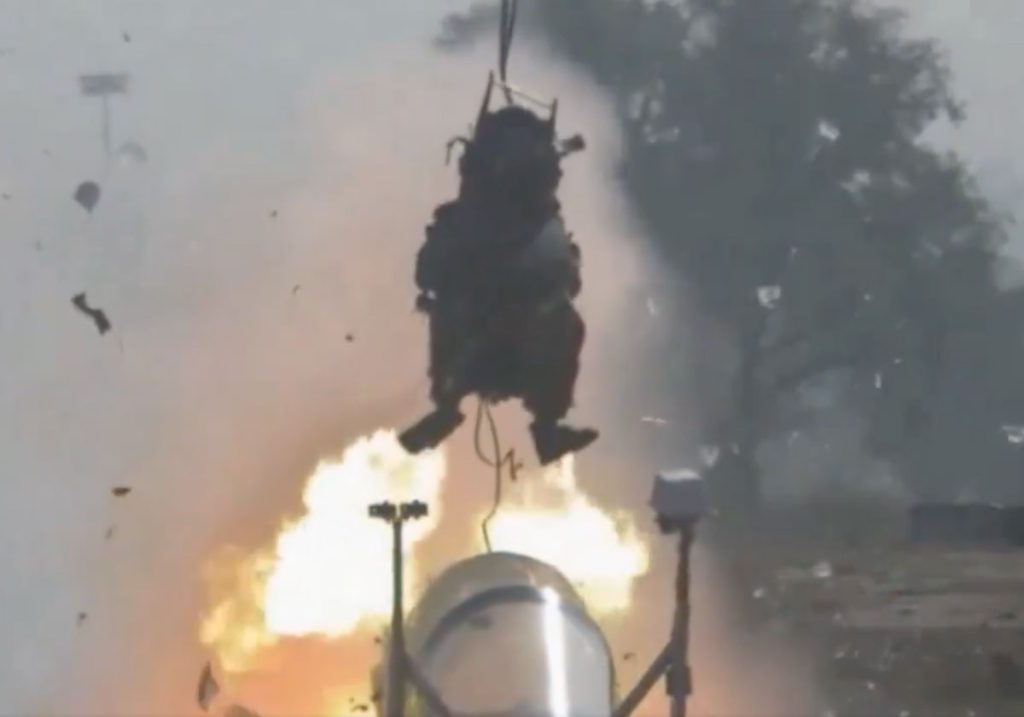
A thunderous roar shattered the quiet expanse of the Terminal Ballistics Research Laboratory in Chandigarh, propelling a sleek test rig along razor-straight rails at the blistering pace of 800 kilometers per hour, faster than the scream of a supersonic jet at low altitude.
The test was not a missile launch or a hypersonic gamble, but a meticulously orchestrated ballet of survival – the Defence Research and Development Organisation’s (DRDO) latest triumph in engineering a much-needed escape route for the nation’s fighter pilots, whose split-second decisions can be very critical.
The high-stakes demonstration, unveiled on December 2, unfolded at the Rail Track Rocket Sled (RTRS) facility, a four-kilometer engineering marvel commissioned in 2014, where solid-fuel rockets ignite in choreographed bursts to mimic the chaos of aerial combat. At the heart of the trial was the forebody of a Light Combat Aircraft (LCA) Tejas, India’s homegrown lightweight fighter, strapped to a dual-sled apparatus. As the system hurtled forward, sensors and cameras captured every nuance, the explosive severance of the cockpit canopy, the flawless sequencing of the ejection seat’s rocket boosters, and the gentle bloom of a recovery parachute cradling an anthropomorphic test dummy rigged with accelerometers to echo the G-forces a human pilot might endure.Success was unequivocal.
‘This isn’t just a test; it’s a testament to our resolve for self-reliance,’ declared DRDO Chairman Dr. Samir V. Kamat in a post-trial briefing, his voice steady amid the acrid scent of expended propellants lingering on the frost-kissed tracks.
The dummy, standing in for a flesh-and-blood aviator, registered survivable loads throughout the sequence, confirming that in the event of catastrophe, be it engine failure mid-dogfight or structural betrayal at Mach speeds, the escape mechanism would deliver its charge intact to the ground below.
Unlike static ground simulations or zero-velocity ejections, this dynamic ordeal replicated the fury of flight, where wind shear and momentum conspire against every bolt and seam.
Engineers from the Aeronautical Development Agency (ADA), the brains behind Tejas’s evolution, fine-tuned the forebody’s aerodynamics, while Hindustan Aeronautics Limited (HAL) integrated the ejection hardware drawn from indigenous designs. Indian Air Force observers, including specialists from the Institute of Aerospace Medicine, scrutinized the data in real-time, their nods of approval sealing the trial’s certification pathway.
The integration promises ripple effects, as in enhanced safety for Tejas squadrons already patrolling India’s volatile borders, and a blueprint for the fifth-generation Advanced Medium Combat Aircraft (AMCA) looming on the horizon.
Defence Minister Rajnath Singh hailed the breakthrough. ‘A proud stride toward Aatmanirbhar Bharat – India now joins the vanguard of nations mastering in-house escape technologies.’ Similar sentiment echoed across social media, where videos of the sled’s fiery acceleration racked up millions of views, blending awe with national fervor.
Yet beneath the jubilation lies a sobering imperative. Fighter aviation’s grim ledger, where ejections save lives but underscore the razor-edge of risk, demands such innovations. Globally, ejection seats have rescued over 20,000 aircrew since World War II, but failures at high speeds remain a specter, as seen in recent international incidents where canopy jettison faltered under duress.
The RTRS track, a penta-rail beast capable of Mach 2 sprints, vets everything from missile warheads to ISRO’s Gaganyaan parachutes. This latest run adds another chapter to its legacy.