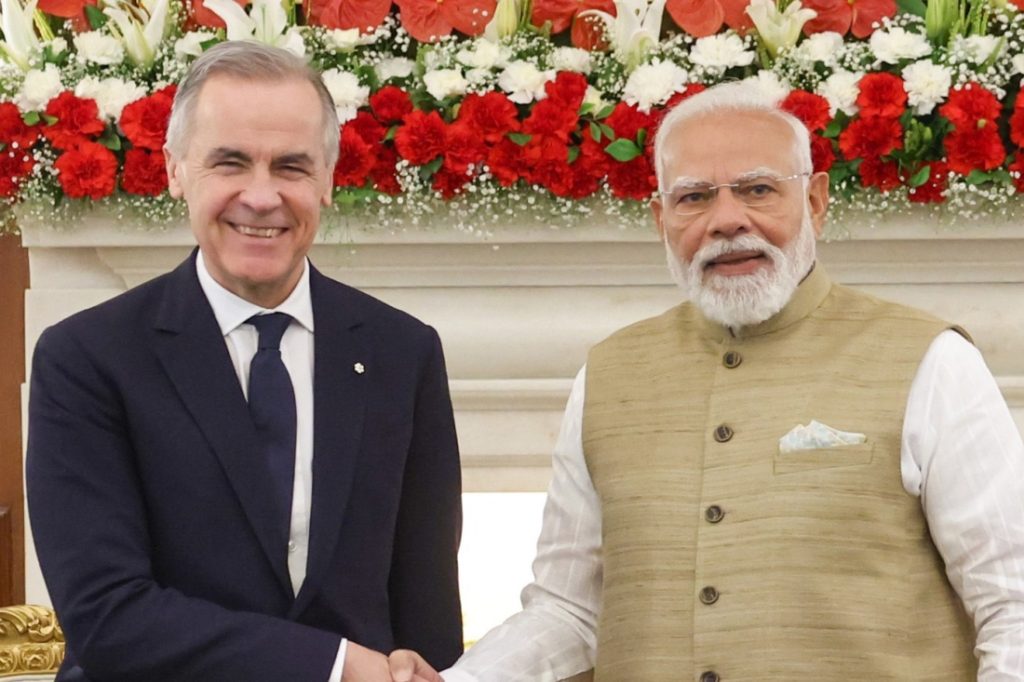
Just days after Canadian Prime Minister Mark Carney wrapped up his four-day official visit to India, both nations are signalling a decisive thaw in ties strained for nearly three years, with fresh commercial pacts and renewed high-level engagement pointing to a pragmatic reset focused on energy security, talent mobility, and economic resilience.
Mr. Carney’s trip, the first full bilateral visit by a Canadian prime minister since Justin Trudeau’s troubled 2018 tour, ran from February 27 to March 2 and culminated in substantive talks with Prime Minister Narendra Modi at Hyderabad House.
The two leaders released a joint statement that deliberately sidestepped past diplomatic friction and instead emphasised shared democratic values, respect for sovereignty, and a common desire to navigate an uncertain global order.
At the heart of the deliverables was a CAD 2.6 billion long-term commercial agreement under which Saskatchewan-based Cameco will supply uranium to India’s Department of Atomic Energy. The deal, welcomed explicitly in the joint statement, is expected to bolster India’s civilian nuclear programme and support its clean-energy transition goals.
Officials described it as a cornerstone of the newly relaunched India-Canada Strategic Energy Partnership, which also opens doors for expanded trade in LNG, LPG, and critical minerals.
The leaders also agreed to fast-track negotiations for a Comprehensive Economic Partnership Agreement (CEPA), setting an ambitious target to conclude talks before the end of 2026. Business leaders accompanying PM Carney announced multiple investment commitments, while both governments launched a Canada-India Talent and Innovation Strategy that includes 13 new university partnerships, expanded research internships for Indian students in Canada, and pathways for skilled professionals in artificial intelligence, clean technology, and supply-chain management.
Additional memoranda of understanding were signed on critical minerals cooperation, clean energy collaboration (covering solar, wind, hydrogen, and battery storage), and cultural exchanges.
The two sides also reactivated several stalled institutional mechanisms, including the Ministerial Energy Dialogue and a revamped CEOs Forum, and confirmed the return of diplomatic personnel to full strength in each other’s capitals.
Canadian Prime Minister Carney told reporters after the summit that the partnership reflected ‘two confident, ambitious nations who want to build the future, together.’ PM Modi, in turn, described the visit as having laid ‘a strong foundation for a truly renewed partnership,’ highlighting the alignment between India’s Viksit Bharat vision and Canada’s economic diversification priorities.
The normalisation comes after relations hit a low in 2023-24 when Ottawa accused Indian agents of involvement in the killing of a Canadian Sikh activist, allegations New Delhi has consistently rejected. Under PM Carney, who succeeded Trudeau in 2025, both governments quietly began rebuilding trust through back-channel talks, G7 and G20 sidelines meetings, and increased ministerial travel.
Analysts say the speed of progress, more high-level engagement in the past 12 months than in the previous two decades combined, reflects a mutual recognition that neither country can afford prolonged estrangement at a time of global supply-chain volatility and shifting trade alignments.
With PM Modi now formally invited to visit Canada later this year, officials on both sides are already preparing the next phase of cooperation, including defence dialogues and joint work on maritime security.