As the world grapples with climate change and energy security, India is emerging as a global leader in renewable energy.
From April 2025 to January 2026, the country added an impressive 34.95 GW of solar capacity, propelling its total installed solar power to 140.60 GW by the end of January. The rapid expansion showcased India’s commitment to its ambitious target of 500 GW of non-fossil fuel capacity by 2030, with solar playing a pivotal role.
Record-breaking additions
The surge in solar installations has been driven by a combination of government policies, technological advancements, and increasing domestic manufacturing capabilities.
In January 2026 alone, India commissioned 4.79 GW of new solar capacity, contributing to a total renewable energy addition of 4.93 GW for the month. This follows a strong performance in 2025, where the first nine months saw 26.6 GW of solar additions – a 54% increase year-over-year.
A breakdown of the cumulative solar capacity as of January 31, 2026, reveals a diverse portfolio:
Ground-Mounted Solar Plants – 107.26 GW
Grid-Connected Solar Rooftop – 24.30 GW
Hybrid Projects (Solar Component) – 3.36 GW
Off-Grid Solar 5.68 GW
Total Solar 140.60 GW
This growth has elevated India’s overall non-fossil fuel capacity to 271.97 GW, positioning solar as the third-largest source of electricity in the country, behind hydropower.
Government initiatives have been instrumental. The Union Budget for 2026-27 emphasizes clean energy with incentives for domestic solar manufacturing, including customs duty exemptions for key components.
Starting June 1, 2026, all solar projects must use locally manufactured cells under the Approved List of Models and Manufacturers (ALMM) and Approved List of Cells and Modules (ALCM) policies, boosting self-reliance.
India’s solar module manufacturing capacity is projected to exceed 165 GW by 2027, supported by schemes like the Production Linked Incentive (PLI).
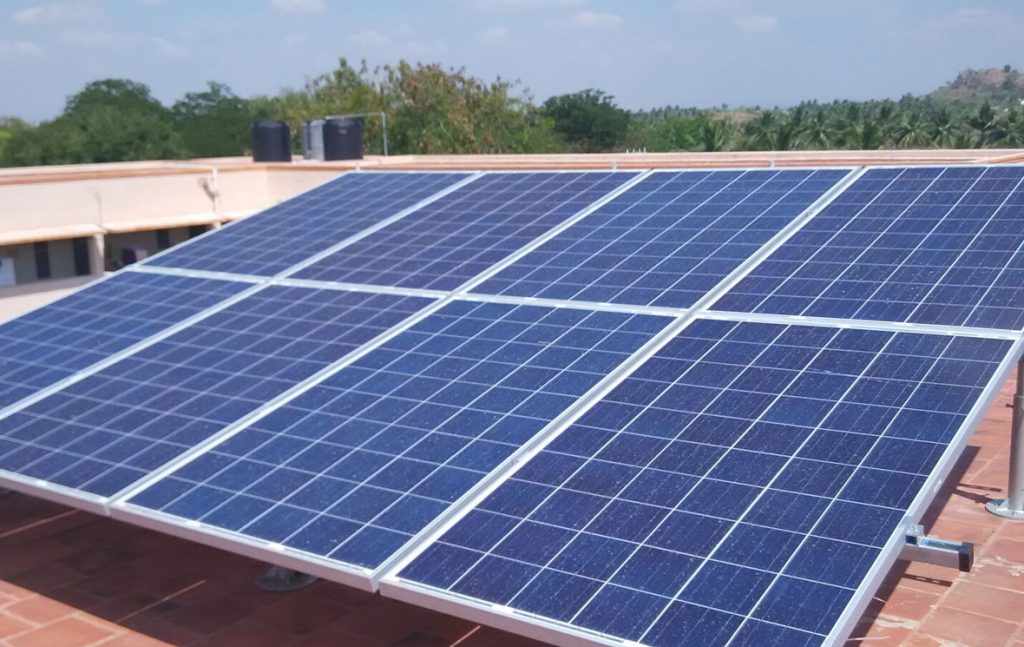
Rooftop and decentralized solar
Beyond large-scale projects, rooftop and decentralized solar installations are transforming rural and urban landscapes. Over 2.4 million homes have adopted rooftop solar through government programs, with expectations of doubling to 4 million by March 2026.
As of October 2025, more than 547,000 decentralized renewable energy (DRE) systems were operational, impacting nearly 37 million livelihoods in sectors like agriculture and small enterprises.
Even niche sectors are embracing solar. For instance, the Northeast Frontier Railway (NFR) achieved a cumulative solar capacity of 18.4 MWp by December 2025, with a 373% increase in rooftop installations compared to the previous year.
Iconic projects
India boasts some of the world’s largest solar parks, such as the Bhadla Solar Park in Rajasthan, with a capacity of 2.245 GW. These mega-projects highlight the scale of India’s ambitions.
Globally, India ranks third in solar capacity and fourth in overall renewables. The International Energy Agency (IEA) forecasts that solar generation could reach 200 GW by the end of the decade, fueled by falling storage costs and integration with battery energy storage systems (BESS). The BESS market in India is expected to grow to USD 19.45 billion by 2035.
Challenges?
The progress is undeniable as solar capacity has grown over 25 times in the past decade, yet challenges remain.
Supply chain issues and grid integration need attention, but with policies promoting smarter grids and distributed solar, India is shifting from mere capacity addition to system-wide transformation.
As India aims for net-zero emissions by 2070, solar power’s role in powering industries, communities, and smart cities will only expand. The momentum not only enhances energy security but could also create millions of jobs, paving the way for a sustainable future.