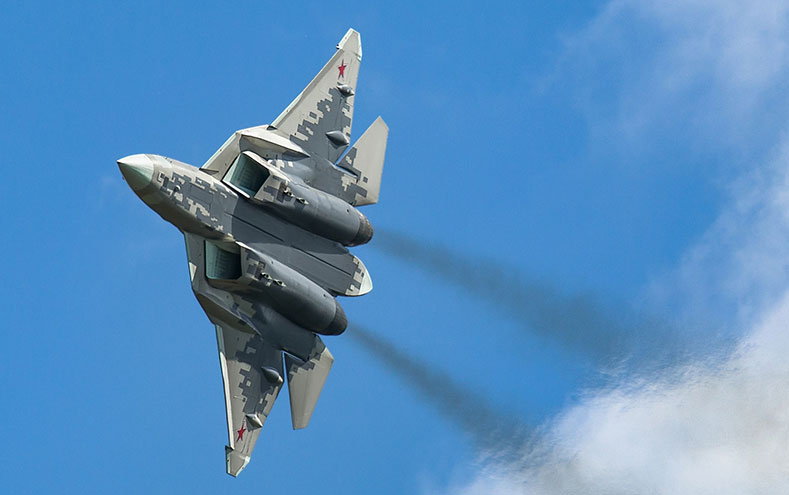
Russia has extended an unprecedented offer to India for complete technology transfer and joint manufacturing of the advanced Su-57 stealth fighter jet, positioning the proposal as a cornerstone for New Delhi’s future aerial capabilities.
The overture, unveiled on the sidelines of the Dubai Airshow, comes just weeks before Russian President Vladimir Putin’s scheduled December visit to India, signaling Moscow’s intent to align with India’s ‘Make in India’ initiative amid evolving global security challenges.
Senior officials from Russia’s state arms exporter Rosoboronexport detailed the plan during high-level meetings with Indian delegations, proposing an initial batch of Su-57E export variants built in Russian facilities, followed by licensed production at Indian aerospace hubs.
The package emphasizes a two-seat trainer configuration tailored for India’s pilot training needs, complete with unrestricted access to proprietary avionics, engine designs, and stealth coatings, addressing long-standing concerns over intellectual property barriers in past Indo-Russian projects.
Moscow has already stated that India’s demands for full indigenization are ‘entirely feasible and mutually beneficial.’ The Su-57, Russia’s flagship fifth-generation multirole fighter, boasts supercruise speeds exceeding Mach 2, integrated sensor fusion, and low-observable features honed through combat deployments in Syria and Ukraine.
For India, which operates a mix of aging MiG-21s and Rafales while developing its own Advanced Medium Combat Aircraft (AMCA), the partnership could accelerate squadron modernization without sole reliance on suppliers.
Rosoboronexport’s Director General Alexander Mikheyev highlighted the offer’s flexibility, noting it could integrate BrahMos supersonic missiles—already co-produced with India onto the Su-57 platform for enhanced strike versatility. Indian Air Force representatives at the airshow expressed measured interest, pointing to the need for cost-effective lifecycle support and interoperability with existing fleets.
The development comes as India navigates US overtures under the Multi-Role Fighter Aircraft program and domestic pushes for AMCA prototypes by 2028. The timing also underscores Russia’s aggressive pivot toward Asia-Pacificpartners, strained by Western sanctions over Ukraine but buoyed by India’s neutral stance in global forums.
Analysts view the Su-57 deal as a counter to China’s J-20 dominance in the region, potentially fortifying India’s deterrence along the Himalayan borders.
Yet, challenges loom. The funding constraints for India’s $100 billion-plus defense pipeline and geopolitical sensitivities around sourcing from a sanctioned nation could temper enthusiasm. As the Dubai Airshow wraps up, follow-up talks are slated for Russian President Putin’s India trip, where bilateral defense trade, already topping $15 billion annually, could see fresh memoranda.
For Moscow, securing India as the Su-57’s first major export collaborator would validate the program’s viability beyond domestic needs, while for New Delhi, it offers a pragmatic bridge to self-sufficiency in stealth aviation. With prototypes potentially rolling out from Hindustan Aeronautics Limited by 2030, this overture could redefine Indo-Russian ties in the jet age.