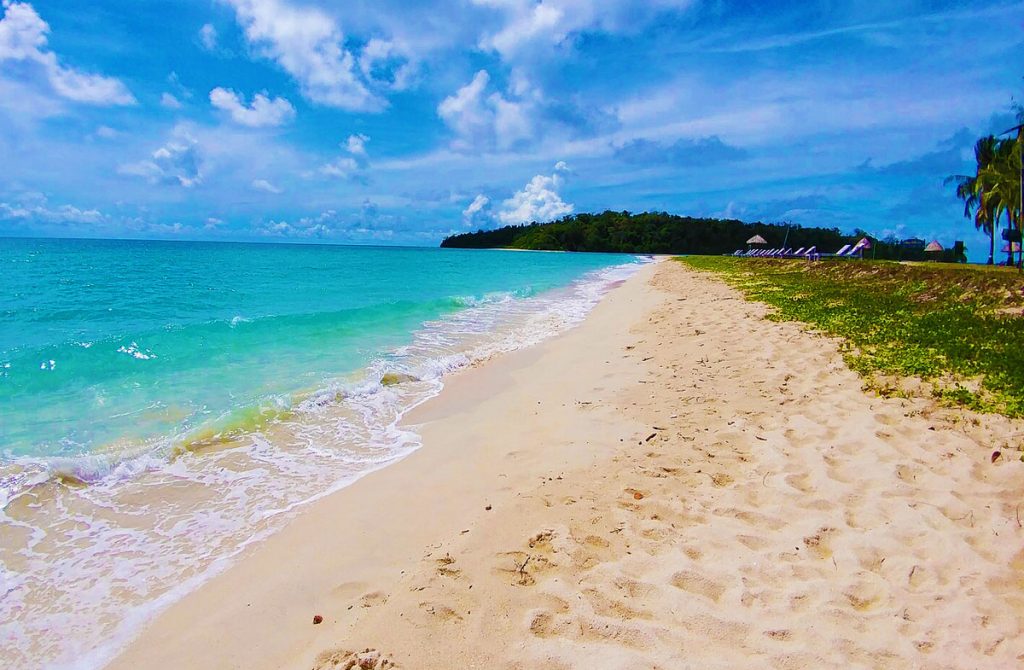
In the turquoise expanse of the Andaman Sea, where ancient rainforests meet the vast Indian Ocean, the government is forging ahead with one of its most ambitious infrastructure dreams – transforming Great Nicobar Island into a bustling economic powerhouse.
The Great Nicobar Project
Dubbed the ‘Jebel Ali of the East,’ the ₹81,000 crore ($9.4 billion) Great Nicobar Island Development Project is expected to catapult the remote outpost into a global trade nexus.
Envisioned as a multifaceted mega-development, the project encompasses a sprawling transshipment port at Galathea Bay, capable of handling up to 16 million twenty-foot equivalent units (TEUs) of cargo annually, rivaling Singapore’s dominance in regional shipping.
Flanking it will be a greenfield international airport with a 3,300-meter runway, poised to serve 4,000 passengers per hour, alongside a hybrid gas-and-solar power plant generating 450 megawatts to fuel the endeavor.
Two coastal townships, one accommodating up to 65,000 residents, will sprout amid luxury resorts, an industrial hub, and a cruise terminal, all spread across 166 square kilometers outside the protected Galathea National Park.
The blueprint, crafted by NITI Aayog and executed by the Andaman and Nicobar Islands Integrated Development Corporation (ANIIDCO), unfolds in phases over three decades, with the first leg targeting operational status by 2028.
The seeds of this ambition trace back to 2021, when the Union Cabinet greenlit the initiative amid India’s push to fortify its maritime footprint in the Indo-Pacific. Positioned at the mouth of the Six Degree Channel, a vital sea lane between the Andaman and Nicobar archipelago, the island’s deep natural harbor offers strategic primacy.
Proponents, including Home Minister Amit Shah, hail it as a multiplier for India’s maritime trade, potentially siphoning 20-30% of cargo currently routed through foreign ports like Colombo and Singapore. Maritime historian Rajesh Gopalan likens it to Dubai’s Jebel Ali, a free-trade oasis that could bolster surveillance against Chinese naval incursions and weave economic ties across Southeast Asia.
Bids for the port’s construction, valued at ₹41,000 crore, drew heavyweights like Adani Ports and JSW Infrastructure in early 2023, while recent tenders for solar components signal momentum.
Yet, beneath the economic allure lies a storm of contention.
Potential impact on the local environment
Critics warn that this vision could unravel the fragile tapestry of biodiversity and indigenous life that has defined the island for millennia.
Environmentalists decry the project as a potential peril to one of Asia’s last untouched ecosystems. Phase one alone mandates clearing roughly 50 square miles of pristine rainforest, felling an estimated one million trees or up to 10 million, per ecologists, paving the way for dredging in Galathea Bay that could suffocate rainbow-hued coral reefs, seagrass meadows, and habitats teeming with dugongs, dolphins, whales, and over 2,500 species of flora and fauna. Endangered leatherback sea turtles, with just 618 nests recorded in 2023-24, could face obliteration as artificial lights and habitat fragmentation disrupt their ancient migrations.
Saltwater crocodiles, Nicobar macaques, and coconut crabs, relics of evolutionary isolation, teeter on the brink, while translocation efforts for corals and hatchlings are dismissed as futile Band-Aids on a gaping wound. Compounding the peril, the island straddles a volatile fault line; a 2004 tsunami submerged its southern tip by 15 feet, and July 2025’s earthquake swarm has reignited fears of volcanic unrest or another cataclysm.
No less harrowing are the human stakes.
Great Nicobar is home to the Shompen, a reclusive hunter-gatherer tribe of 200-400, and the Nicobarese, numbering around 1,761, whose ancestors were uprooted by the 2004 disaster. The influx of 350,000 settlers, ballooning the population nearly 40-fold, threatens to sever the Shompen’s forested lifelines, exposing them to diseases they’re unequipped to fight and echoing the colonial-era wipeout of eight Andamanese groups.
A GIS map for denotifying portions of the tribal reserve, essential for site clearance, awaits final tweaks post-consultations with local commissioners and the Andaman Adim Janjati Vikas Samiti. Forest rights claims may have to be resolved first, despite ongoing Calcutta High Court challenges asserting prior settlements.
Transit housing for workers stands ready, and a Comprehensive Tribal Welfare Plan, due next month, pledges to weigh Nicobarese repatriation bids alongside provisions for housing, jobs, farmland, and connectivity.
In a nod to cultural preservation, the plan greenlights initiatives like the ‘Shompen Katha’ research, while deep-sea mining blocks off the coast—awarded earlier this year, feed funds into ecological offsets via an Offshore Areas Mineral Trust.
With phase two looming to engulf 90 square miles, a fifth of the island, the Great Nicobar saga embodies India’s high-wire act – leapfrogging into superpower status without sacrificing its wild heart.
Prime Minister Narendra Modi, sharing supportive op-eds, framed it as a ‘strategic imperative,’ but voices from Congress leader Sonia Gandhi to global watchdogs demand a reckoning.