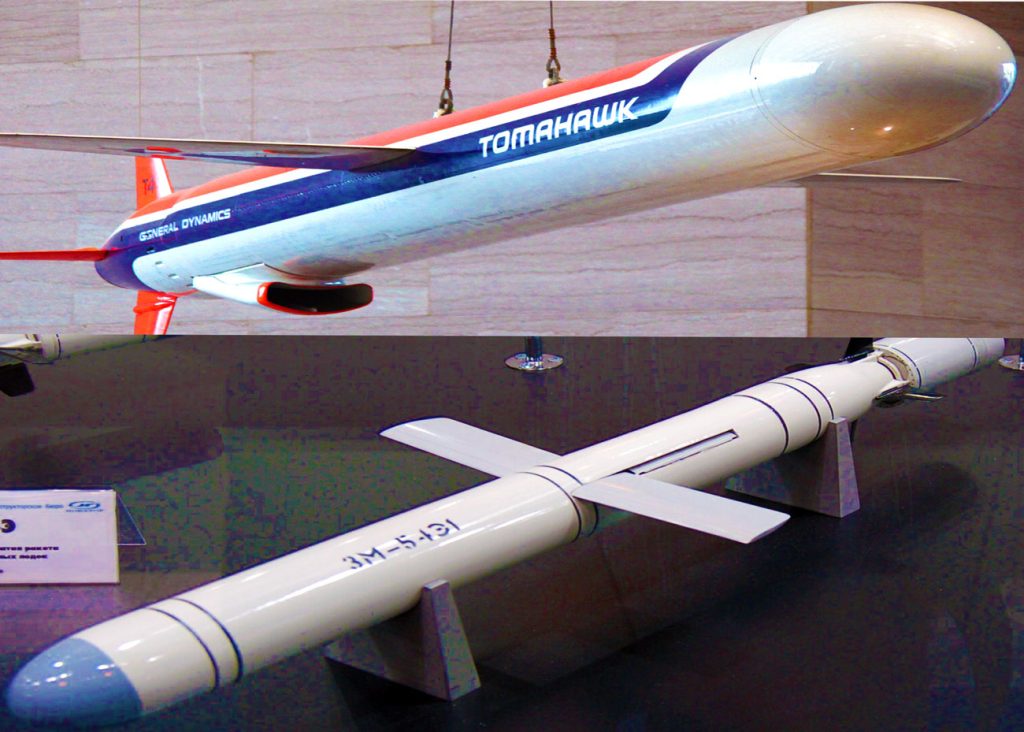
As the United States considers giving Ukraine its Tomahawk missiles, the question arises whether the Russian Kalibr is a weapon capable of countering the Tomahawk.
Tomahawk vs Kalibr
The United States’ venerable Tomahawk stands as a symbol of enduring reliability, while the Russian Kalibr embodies the raw thrill of supersonic innovation.
Developed through distinct paths, the Tomahawk, as a Cold War-era mainstay refined over decades, and the Kalibr, serving since the mid-90s, showcase how engineering ingenuity can lethally neutralize specific threats. But which is more powerful?
First, let’s analyze them individually.
The Tomahawk: Endurance and evasion in the shadows
First entering service in the 1980s, the BGM-109 Tomahawk has evolved from a nuclear-capable deterrent into a cornerstone of precision land-attack operations.
Measuring about 5.6 meters in length and weighing roughly 1,470 kilograms in its early variants, the missile’s Block V iteration, deployed widely by the US Navy, prioritizes versatility and survivability.
Launched from surface ships, submarines, or even ground-based platforms, it can reach targets up to 2,400 kilometers away, making it ideal for standoff engagements where operators seek to minimize risk to their forces.
But what truly sets the Tomahawk apart is its stealthy operational doctrine. Cruising at high subsonic speeds around 885 kilometers per hour, it hugs terrain at altitudes as low as 30 meters, employing terrain-following radar and inertial navigation to weave through valleys and evade radar detection.
This low-observable profile, combined with GPS and digital scene-matching area correlator (DSMAC) guidance, delivers warheads with circular error probable (CEP) accuracies under 10 meters, even in adverse weather.
In real-world applications, such as recent naval exercises, this has proven invaluable for suppressing enemy air defenses without alerting adversaries until impact.
The missile’s strength lies in its scalability and integration. With modular payloads ranging from unitary high-explosive warheads to submunitions for area denial, it adapts to missions from surgical strikes on command centers to broader infrastructure disruption.
Moreover, its reprogrammable flight plans allow mid-mission retargeting via satellite links, a feature that enhances its role in dynamic battlefields like the Indo-Pacific, where vast distances demand weapons that can loiter or redirect without recall.
However, its subsonic pace could be a vulnerability against advanced interceptors, but the Tomahawk’s proven track record over 2,000 combat launches with a 90% success rate underscores its reliability as a ‘fire-and-forget’ workhorse.
Kalibr is a blitz of supersonic versatility
Russia’s Kalibr (3M series, NATO: SS-N-27/30) family, operational since 1994, merges anti-ship ferocity with land-attack reach in a compact, export-proven package.
Its variants, like the 3M-14 (land-attack), measure 6.2-8.9 meters in length and weigh 1,300-2,300 kilograms, while the 3M-54 (anti-ship) tips at up to 1,780 kilograms with a sleeker 8.22-meter profile for submarine tubes.
Both variants share a 0.533-meter diameter and 450-kilogram conventional warheads (or 200-kilogram penetrators for sea targets), propelled by a solid-fuel booster and R-95TP turbojet for subsonic Mach 0.8 cruises up to 2,500 kilometers in domestic 3M-14 guise, though export Club versions cap at 300 kilometers to comply with treaties.
The Kalibr’s ace is its dual-speed architecture. The subsonic loiter phases for fuel efficiency give way to Mach 2.5-3.0 terminal sprints in 3M-54 models, compressing defender response times to under 60 seconds and overwhelming systems like Ukraine’s S-300s, as seen in Black Sea salvos.
Guidance fuses inertial systems with GLONASS satellite corrections and active radar homing, yielding 2-3 meter CEPs for infrastructure hits, while sea-skimming at 20 meters evades horizon-limited radars.
Launch flexibility, from Yasen-class subs and Buyan-M corvettes via vertical launch systems, to containerized Club-K ground setups, enables surprise from unexpected vectors, including air-dropped from Su-30s.
Combat-tested in Syria (2015 strikes from Caspian Flotilla at 1,500 kilometers) and Ukraine (over 1,000 launches since 2022, crippling energy grids), the Kalibr’s strengths lie in cost-effectiveness ($1 million per unit domestically) and saturation tactics, where swarms exploit its maneuverability, S-turns at full throttle, to saturate defenses.
2025 developments include the Kalibr-M prototype, pushing ranges to 4,500 kilometers for Pacific patrols, and refined targeting for dynamic threats.
Though reliant on vulnerable Black Sea platforms (seven ships lost by mid-2025), its supersonic punch and modular evolution make it a peer-competitive equalizer, eyed by allies like India for BrahMos integrations.
So, which of these missiles is more lethal?
Pitted against each other, the Tomahawk and Kalibr illuminate divergent yet symbiotic strategies.
The American missile’s prodigious standoff and loiter endurance suits blue-water campaigns, allowing carrier groups to degrade command nodes from afar without exposure, as in hypothetical Taiwan contingencies where hours-long flights enable layered strikes. Its precision ecosystem thrives on information dominance, turning vast oceans into safe launch zones.
The Kalibr, by contrast, favors littoral blitzes, its terminal velocity ideal for choking chokepoints like the Strait of Hormuz or Kerch Bridge, where speed trumps subtlety to deny sea control swiftly.
In a simulated joint scenario, Tomahawks could seed chaos deep inland, while the Kalibr could go on a rampage near coastal areas.