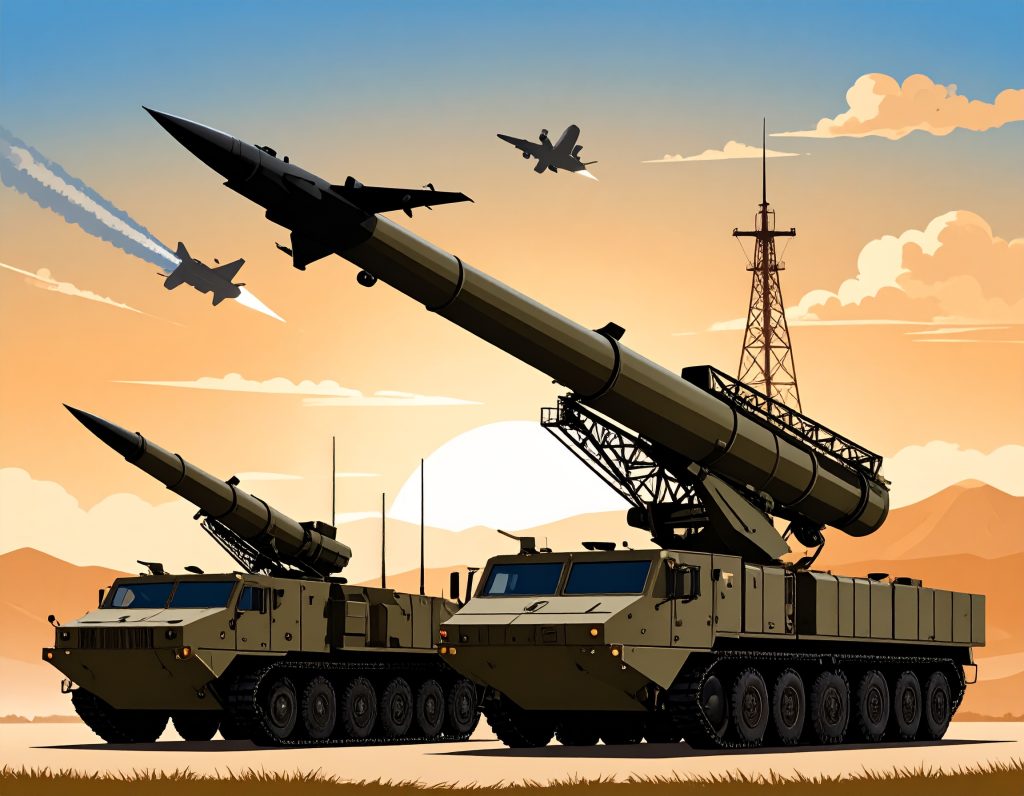
President Donald Trump unveiled plans for an ambitious missile defense initiative dubbed the ‘Golden Dome’ during a press conference in the Oval Office. The proposed system, estimated to cost $175 billion, aims to protect the United States from advanced missile threats, including ballistic, hypersonic, and cruise missiles, potentially launched from anywhere in the world, including space.
Flanked by Defense Secretary Pete Hegseth and Space Force Vice Chief of Space Operations General Michael Guetlein, whom Mr. Trump appointed to lead the project, the president described the Golden Dome as a ‘game-changer’ for national security. ‘This will be the greatest defense system ever built,’ Mr. Trump declared, emphasizing its ability to integrate next-generation technologies across land, sea, and space. He expressed confidence that the system could be fully operational by the end of his term in 2029, a timeline some experts consider ambitious given the technological and logistical challenges.
The Golden Dome draws inspiration from Israel’s Iron Dome, which intercepts short-range rockets but is far more expansive in scope. It envisions a network of hundreds of satellites equipped with sensors to detect and track incoming missiles alongside interceptors capable of neutralizing threats in their boost or mid-flight phases.
President Trump highlighted that the system would be entirely manufactured in the United States, with states like Alaska, Florida, Georgia, and Indiana expected to benefit economically from production and deployment.
The announcement included details of an initial $25 billion funding allocation embedded in a broader legislative package currently under consideration in Congress. However, the Congressional Budget Office estimates that the space-based components alone could cost up to $542 billion over two decades, raising concerns among some lawmakers about the project’s feasibility and potential strain on other defense priorities.
Democratic senators, including Jack Reed of Rhode Island, have questioned the lack of a detailed plan, with some labeling the initial funding as a ‘slush fund.’
Trump also noted international interest, stating that Canada has expressed a desire to participate in the program, with discussions underway to define its role and cost-sharing arrangements. The president referenced growing missile threats from adversaries like China and Russia, which the Pentagon has warned are developing advanced hypersonic weapons capable of evading existing US defenses.
While supporters, including Senate Armed Services Committee Chairman Roger Wicker, view the Golden Dome as a necessary step to counter evolving global threats, skeptics argue it echoes the unfulfilled ambitions of President Ronald Reagan’s Strategic Defense Initiative, or ‘Star Wars,’ which faced insurmountable technical and financial hurdles in the 1980s.